


If you’ve found yourself wondering about EMDR, chances are there’s a part of you that wants relief and another part that feels a little nervous about what therapy might bring up. That makes complete sense. Trauma therapy can sound intimidating, especially if you’ve been holding things together for a long time or you’re not sure you want to reopen old wounds. Curiosity mixed with hesitation is not a red flag. It’s actually a really human place to start.
EMDR therapy, short for eye movement desensitization and reprocessing, is a structured, evidence-based approach that helps the brain process traumatic or distressing experiences in a way that feels more manageable. People often explore EMDR when talking alone hasn’t been enough, or when past experiences are still showing up as anxiety, overwhelm, or feeling stuck in the present.
Here’s what we’ll cover together:
If you’re navigating trauma, a traumatic event, or lingering distress and wondering if EMDR could help, we invite you to keep reading. You don’t have to figure this out alone.
What Is Eye Movement Desensitization and Reprocessing Therapy
When Dr. Francine Shapiro developed eye movement desensitization and reprocessing in the late 1980s, she noticed something curious: certain patterns of rapid eye movement seemed to help reduce the intensity of upsetting thoughts when people recalled them gently with support. That observation eventually grew into a structured approach — movement desensitization and reprocessing therapy — now known simply as EMDR therapy.
Here’s how it works in a real-world, non-clinical sense:
- It’s rooted in the idea of adaptive information processing — a model that suggests our brains naturally heal as our bodies do. Sometimes, a traumatic experience or disturbing event interrupts that process, leaving memories “stuck” with all the original emotions and physical sensations attached. EMDR helps those memories move toward resolution instead of staying frozen in distress.
- Unlike traditional talk therapy that focuses mainly on language and conversation, EMDR invites you to notice sensations, thoughts, and memories while guided through bilateral stimulation, often eye movements, to support that processing.
- While it’s structured (we follow clear steps and phases of EMDR), it’s not rigid. You’re always in control of your pace, and nothing is forced. Think of it as a supported way to let your nervous system complete the processing it couldn’t do at the time of the trauma.
Let’s Find a Path Forward Together
If you’re tired of feeling overwhelmed, stuck in old patterns, or unsure what to do next, I’m here to help you reclaim emotional balance and clarity.
EMDR is one of the most studied treatments for PTSD and trauma, with dozens of controlled trials showing reductions in PTSD symptoms and maladaptive responses after treatment. And beyond PTSD, research suggests EMDR can help with depressive symptoms and other mental health challenges by supporting more adaptive ways of storing and remembering past distress.
So while EMDR might look different from other therapies, at its heart, it’s about helping your brain finally do the healing work it was always built to do, just with a little support and guidance along the way.
What is EMDR therapy and how does it work?
EMDR therapy helps the brain process trauma and distressing experiences so they no longer feel overwhelming. It uses bilateral stimulation, often eye movements, to support the brain’s natural healing process.
When Should EMDR Be Used?
Most of us carry stories from our past — breakups that shook our confidence, job losses that made us question our purpose, grief that left us numb, or years of anxiety that doesn’t seem tied to one event. These distressing memories and patterns can show up as:
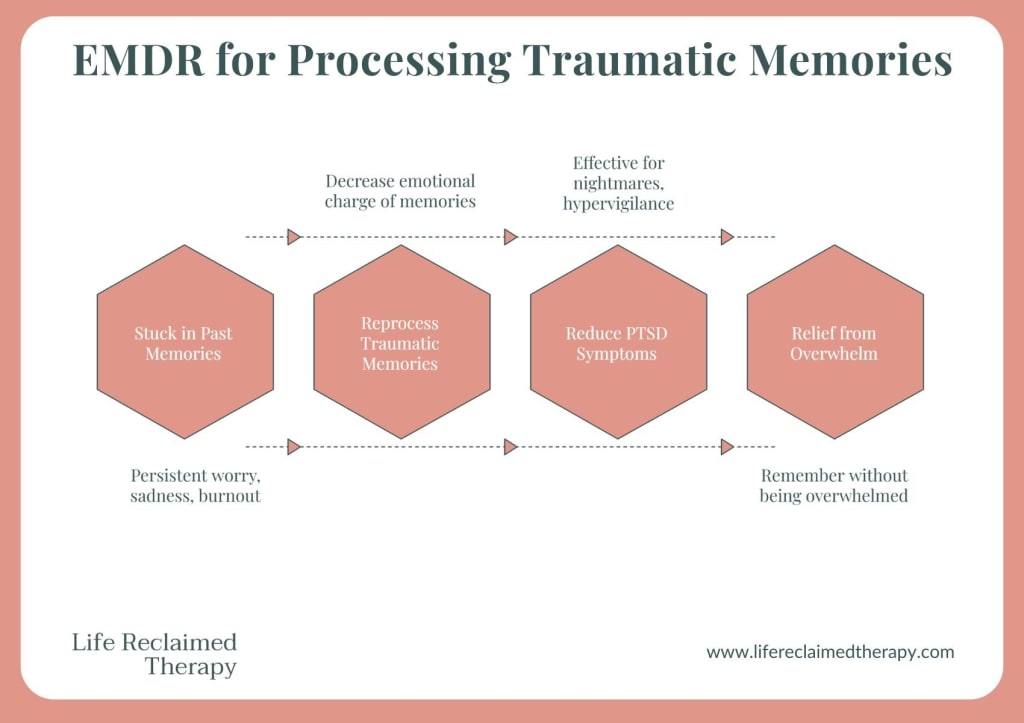
- Persistent worry that doesn’t go away
- Feeling stuck in a loop of sadness or self-doubt
- Burnout that won’t lift even with rest
- Emotional overwhelm that feels bigger than the present moment
If you’ve tried talking through these experiences in cognitive-behavioral therapy or with a therapist and still feel stuck, that’s a sign you might use EMDR to help your brain process what words alone couldn’t.
Using EMDR for PTSD and Trauma
When we talk about treating post-traumatic stress disorder or treating trauma, we’re talking about when distress from a traumatic experience continues to show up as nightmares, hypervigilance, or avoidance long after the event is over. PTSD symptoms can make daily life feel unpredictable and heavy.
The World Health Organization recognizes EMDR as an effective treatment for PTSD, and meta-analyses (which combine many studies) have shown that EMDR can be as effective as trauma-focused cognitive-behavioral therapy for reducing PTSD symptoms in people of all ages.
Unlike some forms of therapy that primarily rely on talking, EMDR helps your brain reprocess traumatic memories so the emotional charge decreases. This doesn’t mean forgetting what happened. It means remembering without being overwhelmed, a shift many people describe as “relief I didn’t think was possible.”
What does research say about EMDR effectiveness?
EMDR effectiveness is well supported by research. Studies show EMDR can be very effective for treating posttraumatic stress disorder and trauma.
What an EMDR Session Actually Feels Like
An EMDR session isn’t like sitting across from someone while you “re-tell” a story over and over again. Instead, here’s how it typically goes:
- You’ll start with check-in — how you’re feeling, what’s come up since last time, and what you’re comfortable focusing on today.
- We’ll talk through goals together, because consent and your pace matter. Nothing is rushed.
- Then, when you’re ready, we’ll invite your mind to notice a thought or trauma memory while guiding bilateral eye movements or other forms of bilateral stimulation. Some people feel tingling, some feel nothing at all; both are okay.
Why Eye Movements and Bilateral Stimulation Are Used
When Dr. Francine Shapiro developed EMDR, she noticed that horizontal eye movements seemed to help disturbing thoughts feel less overwhelming. Today, bilateral eye movements are part of the standard EMDR protocol, but they’re not the only option. We can also use gentle taps or sounds, whatever feels safest for your body.
Here’s what bilateral stimulation helps with:
- It engages both sides of the brain in a rhythmic way.
- It supports your nervous system to reorganize how negative memories are stored.
- It fosters a positive belief about yourself alongside whatever thought you’re processing.
Think of it like guiding your mind to link the distressing part of a memory with a new, soothing context so it feels less “stuck.”
The EMDR Treatment Protocol
EMDR treatment follows a set of clear protocols and procedures, but it’s not a conveyor belt. Think of it more like a roadmap that helps us move thoughtfully and at your pace.
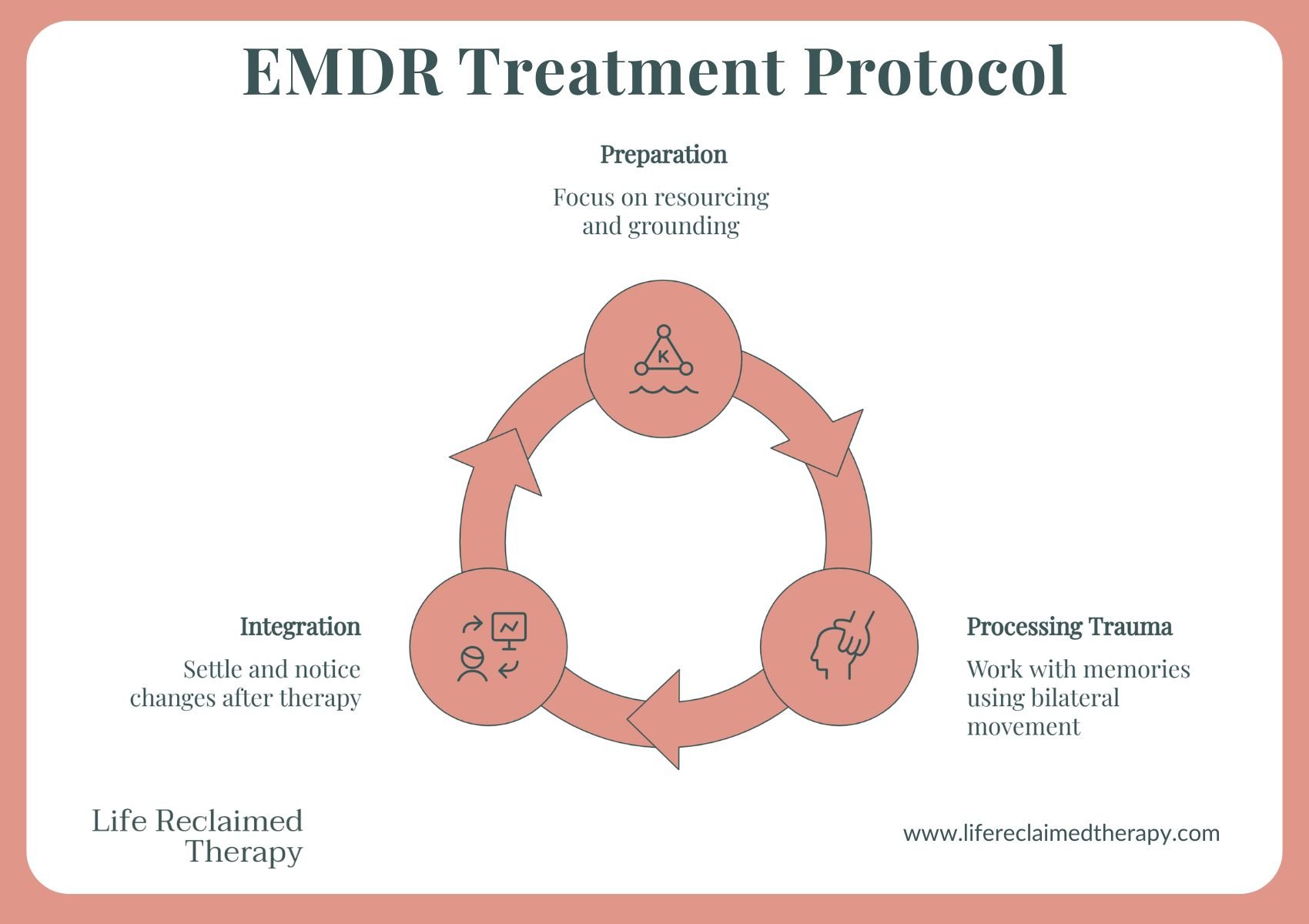
Most EMDR therapy typically includes:
- Preparation first. Before any trauma processing happens, we focus on resourcing, grounding, and nervous system support. This is especially important for symptoms of PTSD and other mental health conditions. You won’t be rushed into traumatic material.
- Processing the trauma. When you’re ready, we gently work with memories associated with the trauma using bilateral movement. This helps the brain fully process what once felt overwhelming, guided by the adaptive information processing model.
- Integration and stabilization. We make space for your system to settle and notice changes after EMDR therapy, including shifts in emotions, beliefs, and body responses.
Can EMDR work if I don’t remember everything clearly?
Yes. EMDR does not require detailed memories. EMDR therapy works with emotions, body sensations, or fragments of experience, which is often enough to support healing and reduce PTSD symptoms.
Benefits of EMDR Therapy Beyond Trauma
While EMDR is widely known for treating post-traumatic stress disorder, its benefits extend far beyond a single diagnosis. Research shows EMDR is effective across a wide range of mental health conditions, including anxiety and depression rooted in earlier experiences.
Many women notice shifts like:
- Less emotional reactivity — moments that once felt overwhelming start to feel manageable
- Greater calm and clarity, even during stressful transitions
- Feeling more present and grounded in daily life, not constantly pulled into the past
How EMDR Helps You Reclaim Trust in Yourself
One of the most meaningful outcomes of EMDR work is reconnecting with yourself. EMDR therapy works by helping your brain process trauma memories through the adaptive information processing model, so you don’t have to relive everything to heal.
Over time, many clients describe:
- Traumatic memories losing their emotional charge
- A quieter nervous system and fewer PTSD symptoms
- A renewed sense of self-trust and confidence in their choices
The goal of EMDR isn’t to erase the past. It’s to help you move forward without carrying its weight. And for women navigating big transitions, that relief can feel life-changing.
Can you use EMDR alongside talk therapy?
Absolutely. EMDR is often used alongside talk therapy as part of trauma treatment. Many therapists combine EMDR with other forms of therapy to support a range of mental health conditions in a gentle, effective way.
Thinking About EMDR? We’re Here When You’re Ready
Exploring EMDR therapy doesn’t mean you’ve decided anything yet. It simply means you’re listening to the part of you that wants support, relief, or maybe just a different way forward. And you don’t have to walk that path alone.
At Life Reclaimed Therapy, our approach to EMDR is gentle by design. We work as a team, and we work with you, not on you. EMDR here is never rushed, never forced, and never one-size-fits-all.
If EMDR feels like something you want to explore more, we invite you to get in touch. Reaching out doesn’t mean you have to be “ready” or have it all figured out. It just means you’re open to support. We’ll meet you exactly where you are and take the next step together, when the timing feels right for you.