


They seemed so nice at first, soft-spoken, thoughtful, maybe even a little wounded. But now? You feel drained, second-guessed, unsure of yourself in ways you never used to. That’s the quiet confusion of being in a relationship with a covert narcissist, someone whose emotional manipulation often hides beneath a mask of sensitivity, victimhood, or charm.
Covert narcissistic abuse can leave you feeling like you’re the problem. But you’re not imagining it. People with covert narcissistic personality traits often use tactics like gaslighting, passive-aggressive behavior, and withdrawal to control their partners.
In this article, we’ll explore:
✨ You deserve clarity. Let’s explore this together.
What Is Narcissism? (It’s Not Always What You Think)
When you hear the word narcissist, you might picture someone loud, arrogant, or obsessed with themselves. But narcissism doesn’t always look like that. Sometimes, it’s quieter, showing up as subtle put-downs, emotional distance, or a pattern of playing the victim. It’s not always easy to spot, especially in relationships that started out feeling warm or safe.
So, what is narcissism?
In simple terms, narcissism is a personality trait that includes:
- A strong need for admiration and attention
- An inflated but fragile sense of self-importance
- Difficulty empathizing with others
- A tendency to react defensively or manipulatively when criticized
It’s also more common than most people realize. One large-scale study found that around 6.2% of people meet the criteria for narcissistic personality disorder (NPD), a more extreme, diagnosable version of these traits. But many more people fall somewhere on the narcissism spectrum without a formal diagnosis.
These traits can show up in relationships in different ways. For example, someone with narcissistic tendencies might:
- Make conversations revolve around themselves
- Use gaslighting to make you question your memory or feelings
- Show little accountability but expect you to meet their emotional needs
- Struggle to show consistent empathy or support
- Respond to boundaries with guilt, blame, or silence
And if you’ve been on the receiving end of these patterns, it can feel confusing, especially if the person doesn’t “seem” like a narcissist on the surface.
If something feels off in your relationship and you’re starting to second-guess yourself, it might be time to look more closely.
What are the signs of covert narcissism?
Emotional withdrawal, guilt-tripping, playing the victim, and leaving you feeling confused or blamed, especially after you express your needs.
What Is a Covert Narcissist?
Not all narcissists are loud, self-absorbed, or obviously cruel. Some are harder to recognize, especially if they seem sensitive, anxious, or misunderstood. That’s the tricky thing about covert narcissism (also known as vulnerable narcissism): it doesn’t always look like narcissism, but it can still leave you feeling confused, invisible, or emotionally drained.
Someone with covert narcissistic traits might:
- Come across as shy or self-deprecating
- Withdraw emotionally when you express needs
- Blame others for their discomfort while avoiding responsibility
- Show a deep sensitivity to feedback or criticism
- Use guilt or silence instead of direct confrontation
On the surface, they may appear “sweet,” “wounded,” or “just insecure.” But under that softness can be a pattern of emotional abuse, one that chips away at your self-trust and makes you question your own reality.
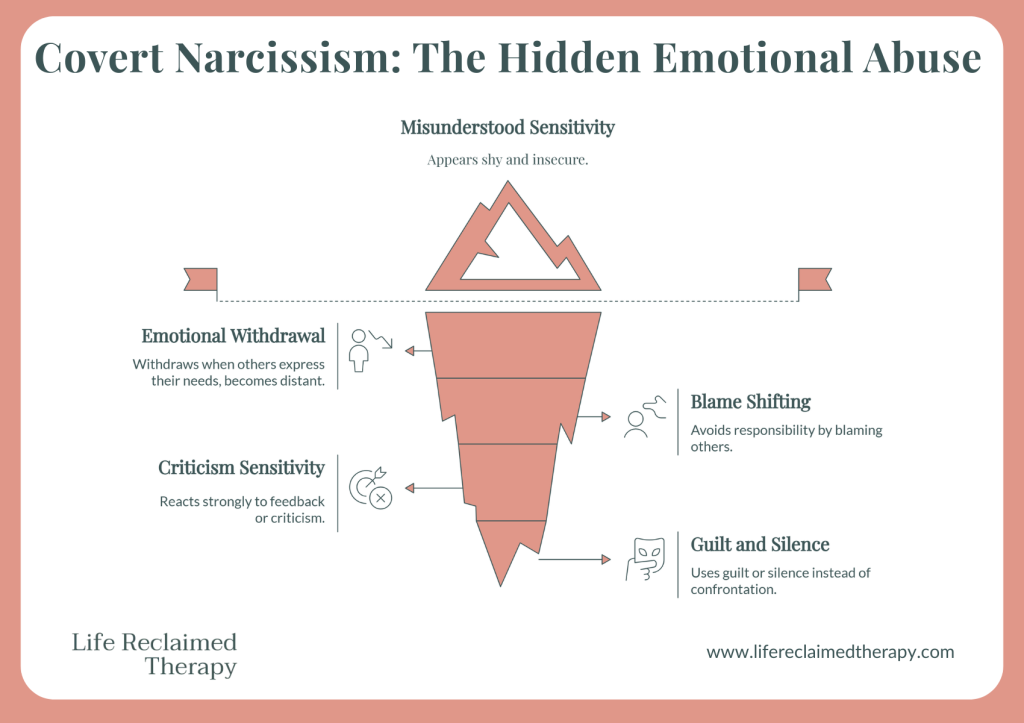
Unlike a more overt narcissist, who might crave praise or dominate conversations, a covert narcissist may rely on passive tactics like gaslighting, emotional distancing, or playing the victim to maintain control. You may find yourself constantly walking on eggshells, never sure what will trigger the next cold shoulder or subtle dig.
This behavior isn’t just frustrating; it’s disorienting. And if you’re in a relationship with a covert narcissist, it can be hard to explain what’s happening to friends and family members because it’s not always obvious.
One study in Personality and Individual Differences found that covert narcissists tend to lack empathy, overvalue their emotional pain, and often believe they’re morally superior to others. They may also experience narcissistic rage when their sense of entitlement is threatened, even if it shows up as silent treatment instead of yelling.
What Is an Overt Narcissist?
If covert narcissism hides in silence, self-pity, and passive aggression, overt narcissism is often the opposite. It’s bold, attention-seeking, and more aligned with the stereotypical image of someone who thinks the world revolves around them.
An overt narcissist might:
- Brag about accomplishments or intelligence
- Dominate conversations and dismiss others’ opinions
- React with anger or contempt when challenged
- Show a lack of empathy in relationships
- Expect special treatment or constant admiration
This behavior stems from a deeper issue. While overt narcissists may seem confident, their inflated self-image is often masking insecurity or shame. Researchers refer to this subtype as grandiose narcissism, and it’s strongly associated with narcissistic personality disorder.
When you’re dealing with a narcissist like this, it can feel like everything becomes about them. Your needs, emotions, or boundaries are often minimized or outright ignored. And while the signs of covert narcissism can be subtle and confusing, overt narcissism tends to be more obvious… but no less painful.
You might hear things like:
- “You’re too sensitive.”
- “I’m just being honest.”
- “You’re lucky to be with me.”
Whether you’re dealing with covert and overt narcissistic behaviors or trying to sort out which is which, what matters most is how the dynamic is impacting you. Emotional manipulation, even when it’s obvious, can still create deep wounds.
Knowing the difference between these styles can help you rebuild trust in your own perceptions. And it’s okay if you’re still untangling what kind of narcissist you were with or whether someone is a narcissist at all. These things take time. Therapy can help you sort through what happened, practice setting boundaries, and begin healing from emotional and psychological abuse at your own pace.
What are the five main habits of a narcissist?
Lack of empathy, blaming others, gaslighting, needing special treatment, and avoiding accountability.
Covert Narcissist Traits That Can Leave You Second-Guessing Yourself
If you’ve ever walked away from a conversation feeling confused, guilty, or like you’re the problem, even when you were just trying to express your truth, that’s something worth paying attention to. That foggy, disorienting feeling is a common experience in relationships with covert narcissists. And no, you’re not being too sensitive or imagining things.
Covert narcissists often use subtle, emotionally manipulative behaviors that don’t scream abuse, but still take a toll over time. These patterns leave many people, especially female partners, questioning their own reality.
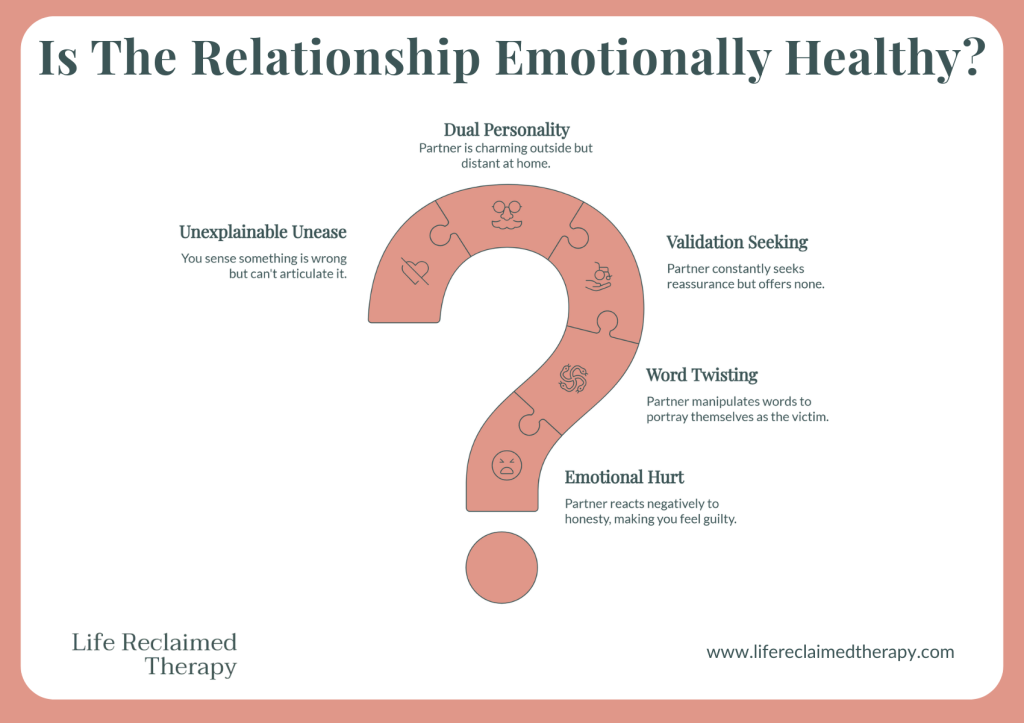
Here are a few signs of a covert narcissist you may recognize:
- They seem deeply hurt or shut down when you speak honestly, making you feel like you’ve done something wrong
- They twist your words to paint themselves as the victim and you as the aggressor
- They constantly seek reassurance or validation, but can’t offer the same in return
- They’re warm and charming around others, but emotionally distant at home
- You often feel like something’s off, but it’s hard to explain why
This is the kind of emotional confusion that makes it especially hard to deal with a covert narcissist. Unlike grandiose narcissists, covert ones may act anxious, sensitive, or self-effacing, but beneath the surface is a strong need for control, narcissistic supply, and power in the relationship.
Research shows that covert narcissism may stem from a mix of temperament, childhood attachment trauma, and learned patterns of emotional avoidance. And while covert narcissism isn’t always easy to detect in a personality test, the impact is real, especially for those who begin to lose trust in their own emotions and instincts.
If you’re finding yourself second-guessing everything, please know: that confusion is a red flag, not a personality flaw. Victims of covert emotional manipulation often say they didn’t realize what was happening until they were deep in it.
Weird Things Covert Narcissists Do (That Might Feel Familiar)
Unlike what you might hear on a covert narcissism podcast or in dramatic relationship stories, covert narcissists may also engage in behaviors that fly under the radar but still leave lasting emotional bruises. These aren’t the big, explosive moments. They’re the quiet, confusing ones that leave you wondering if it’s you.
Here are a few behaviors that might sound familiar:
- Withholding affection after you express a need, as if your honesty has somehow offended them
- Using guilt to gain control, like saying “I guess I’m just a terrible partner” when you bring up concerns
- Turning every conversation back to themselves, even when you’re the one needing support
- Minimizing your emotions by calling you “dramatic,” “too sensitive,” or “overthinking”
- Giving the silent treatment, not out of reflection, but as a form of emotional punishment
These moments don’t always look like abuse, but over time, they can leave you feeling emotionally exhausted and unsure of yourself. Psychologists sometimes call this kind of dynamic “death by a thousand paper cuts.” It’s slow, subtle, and incredibly disorienting.
If this sounds familiar, it’s not because you’re too sensitive; it’s because something is happening that doesn’t feel safe. And that deserves your attention.
What causes someone to be a covert narcissist?
Often a mix of early emotional wounds, insecure attachment, and learned behavior from childhood.
Why It’s So Hard to Leave or Set Boundaries with a Covert Narcissist
If you’ve found yourself stuck in the loop of “Why am I still here?”, take a deep breath. That question doesn’t mean you’re weak or broken. It means you’re caught in something complicated. When you’re in a relationship shaped by covert narcissistic behaviors, leaving isn’t always as simple as it seems, even when a part of you quietly knows something isn’t right.
One reason it’s so hard? Emotional manipulation hooks you in slowly. A covert narcissist is more likely to draw you in with vulnerability, not vanity. They may seem anxious, emotionally wounded, or like they just “need someone to love them.” And if you’re naturally caring and empathetic, this can create a powerful pull.
Let’s Find a Path Forward Together
If you’re tired of feeling overwhelmed, stuck in old patterns, or unsure what to do next, I’m here to help you reclaim emotional balance and clarity.
Here are a few reasons why setting healthy boundaries or leaving might feel impossible:
- Trauma bonding: When affection and emotional withdrawal are given in unpredictable cycles, your brain learns to crave the moments of closeness, even if they’re rare or conditional.
- Self-blame: Because the manipulation is subtle, it’s easy to believe you’re the one overreacting. A narcissist doesn’t usually scream or rage, instead, they might go quiet, shut down, or act wounded.
- Fear of abandonment: Covert narcissists seem like they need you. You may feel guilty imagining how they’d fall apart if you left, even if you’re the one hurting.
What makes this dynamic especially difficult is that a narcissist will use guilt, silence, or “poor me” narratives to keep you in the role of caretaker. Covert narcissists are also known for testing your boundaries in ways that feel emotional rather than aggressive, making it even harder to spot what’s happening.
If this resonates with your narcissist experiences, it’s okay to feel conflicted. Change doesn’t have to be immediate or dramatic. Sometimes, the first step is simply recognizing that this pattern is hurting you, and that you deserve something steadier, safer, and more mutual.
How to Deal with a Covert Narcissist (Without Losing Your Sense of Self)
So if you’ve been reading through all of this and thinking, Okay… this sounds familiar. Now what? Recognizing the signs is one thing. Figuring out how to respond to them is another.
Let’s talk about what it really looks like to deal with a covert narcissist in everyday life without losing your sense of self in the process.
Here’s how to start protecting your peace:
Recognize the pattern
If every honest conversation somehow ends with you apologizing, or if you constantly feel blamed or unseen, that’s a red flag, not a reflection of your worth. You don’t need a formal diagnosis of narcissistic personality disorder to name what’s hurting you.
Stop over-explaining
When you’re caught in emotional manipulation, it’s easy to try and “fix” the dynamic by being more understanding, more patient, clearer. But a narcissist would often rather stay in control than meet you halfway. You don’t owe endless explanations to someone who refuses to hear you.
Set firm, kind boundaries
This might mean saying no, limiting deep conversations, or simply stepping back emotionally. Boundaries aren’t punishments, they’re a form of self-respect.
Get support
Therapy is a safe place to explore what’s happening without shame. Therapy care can help survivors of overt or covert emotional abuse regain confidence, rebuild trust in their perceptions, and practice healthy relational patterns.
Remember, understanding the causes of covert narcissism isn’t about excusing the behavior; it’s about freeing yourself from the cycle. You deserve relationships where your needs are heard, your feelings matter, and your voice isn’t something you have to defend
How do I detach from a covert narcissist?
Start with small steps, like setting boundaries, limiting contact, and getting support. You don’t have to figure it all out alone.
Not Sure What’s Going On in Your Relationship? That’s a Good Enough Reason to Reach Out
Sometimes, the hardest part isn’t the relationship itself; it’s the quiet confusion it leaves behind. You might still be replaying conversations in your head, wondering if you were overreacting, if you should’ve said it differently, or if the whole thing was your fault. That’s often what covert and overt emotional manipulation does: it makes you doubt your own reality.
But here’s the truth, you don’t need a diagnosis or a crisis to reach out for support. If something feels emotionally draining, hard to name, or just off, that’s enough of a reason to begin individual relationship therapy.
Therapy is not about labeling anyone. It’s about creating space for you: your voice, your feelings, and your needs.
In our work together, we can:
- Untangle confusion from gaslighting, guilt, or manipulation
- Reconnect you with your own truth, even if you haven’t trusted it in a while
- Practice setting healthy boundaries in ways that feel grounded, not harsh
- Gently process past emotional and psychological abuse, at your own pace
If you’ve been dealing with covert narcissism or trying to make sense of a relationship that doesn’t quite add up, therapy can help you step out of survival mode and into clarity.
This isn’t about judging yourself for staying too long or not seeing the signs. Covert narcissists are also skilled at hiding patterns behind emotional neediness, confusion, or charm. If any of this rings true, therapy offers a place to finally exhale and start rebuilding from a steadier foundation.
You’re allowed to want more peace. You’re allowed to want something different. Let’s take the next step together. Reach out!