


You’ve talked about it. Maybe for years. You can recite the story of what happened to you in perfect order, and you can name exactly why it still bothers you. And yet your chest still tightens before a hard conversation. Your shoulders still creep up toward your ears when your phone buzzes at the wrong time. You still feel exhausted in a way that a full night’s sleep doesn’t touch.
If that sounds familiar, I want you to hear this first: you’re not doing therapy wrong, and you’re not broken. Your body might just be holding what your words already worked through.
Trauma isn’t rare. Research from the National Institute of Mental Health suggests about 6.8% of U.S. adults will experience PTSD at some point in their life, and far more people carry the quieter, unnamed weight of a traumatic event without ever meeting that specific label. On top of that, CDC data show that the large majority of U.S. adults report at least one adverse experience in childhood. Trauma, in other words, is common. It is not a character flaw, and it is not something you should have simply thought your way out of by now.
This is where somatic therapy for trauma comes in. In this guide, I’ll walk you through:
Why Talking About It Doesn’t Always Make It Go Away
Here’s something I wish more people knew going into their first round of therapy: your thinking brain and your body don’t always heal at the same pace.
Talk therapy works beautifully for a lot of what trauma leaves behind. But trauma isn’t only stored as a memory you can narrate. It’s also stored as a stress response, wired into your nervous system, ready to fire again when something even loosely resembles the original threat.
Psychiatrist Bessel van der Kolk built an entire body of work around this idea, laid out in his widely read book The Body Keeps the Score. His central point is simple, even if the science behind it isn’t: a traumatic experience can reshape the body’s stress response long after the mind has made sense of what happened.
That’s the fight, flight, or freeze response you’ve probably heard of. When something overwhelming happens and you can’t fight it or run from it, your nervous system sometimes gets stuck partway through that response. The energy never fully discharges. It just waits, quietly, in your muscles, your breath, your gut.
That’s why you can understand your trauma completely and still flinch at a raised voice. Your body isn’t being dramatic. It’s doing exactly what it was built to do: protect you, even when the danger has long since passed.
If you’ve done talk therapy and felt like you were “getting it” intellectually but not really feeling different, this is usually why. You addressed the story. The body-based trauma response was still running in the background.
Let’s Find a Path Forward Together
If you’re tired of feeling overwhelmed, stuck in old patterns, or unsure what to do next, I’m here to help you reclaim emotional balance and clarity.
So, What Is a Somatic Therapist, and What Do They Actually Do?
A somatic therapist is a licensed therapist trained to work with the body alongside the mind. It’s still psychotherapy. You’ll still talk. The difference is that a somatic therapist is also paying attention to what’s happening underneath the words: your posture, your breath, the tension in your jaw, the way your voice changes when you get near something painful.
Instead of only asking “what happened,” a somatic therapist will often ask “what are you noticing in your body right now?” That single shift changes everything about how the work unfolds.
Many somatic therapists hold additional training on top of their clinical license, in modalities like Somatic Experiencing, Sensorimotor Psychotherapy, or Hakomi. You don’t need to memorize those names before your first session. What matters is that your therapist knows how to help you build body awareness safely, at a pace your nervous system can actually handle.
If you’re in or around Calabasas, this is part of what I offer alongside CBT and EMDR: a somatic, whole-person lens on trauma, not just a conversation about it.
Is somatic therapy evidence-based?
Yes, with a growing research base. Studies on Somatic Experiencing, one of the most studied somatic approaches, have shown meaningful reductions in PTSD symptoms compared to waitlist controls, with many participants maintaining those gains a year later.
What Is Somatic Therapy? The Mind-Body Connection Explained
“Somatic” simply means “of the body.” So when people ask what somatic therapy is, the plain-language answer is this: it’s a form of therapy that treats the body as a legitimate source of information, not just a container for the mind.
Think about the physical signs of stress you already know well. A clenched jaw. Shallow, high breathing. A stomach that twists before a hard conversation. Shoulders that live somewhere up near your ears. None of that is random. Your body is constantly registering safety or threat, often before your conscious mind catches up.
Somatic healing is the process of learning to listen to those signals instead of pushing past them. Over time, this kind of body awareness helps you catch stress earlier, understand your own reactions with more compassion, and start to release patterns that have been running on autopilot for years, sometimes decades.
This is also why somatic work shows up so often alongside chronic pain treatment. When the nervous system stays braced for danger long after the danger has passed, that tension has to live somewhere. For a lot of people, it lives in the body as literal, physical pain.
Somatic Therapy vs. Talk Therapy: What’s the Difference?
I don’t want you to walk away thinking somatic therapy replaces talk therapy. It doesn’t. It complements it.
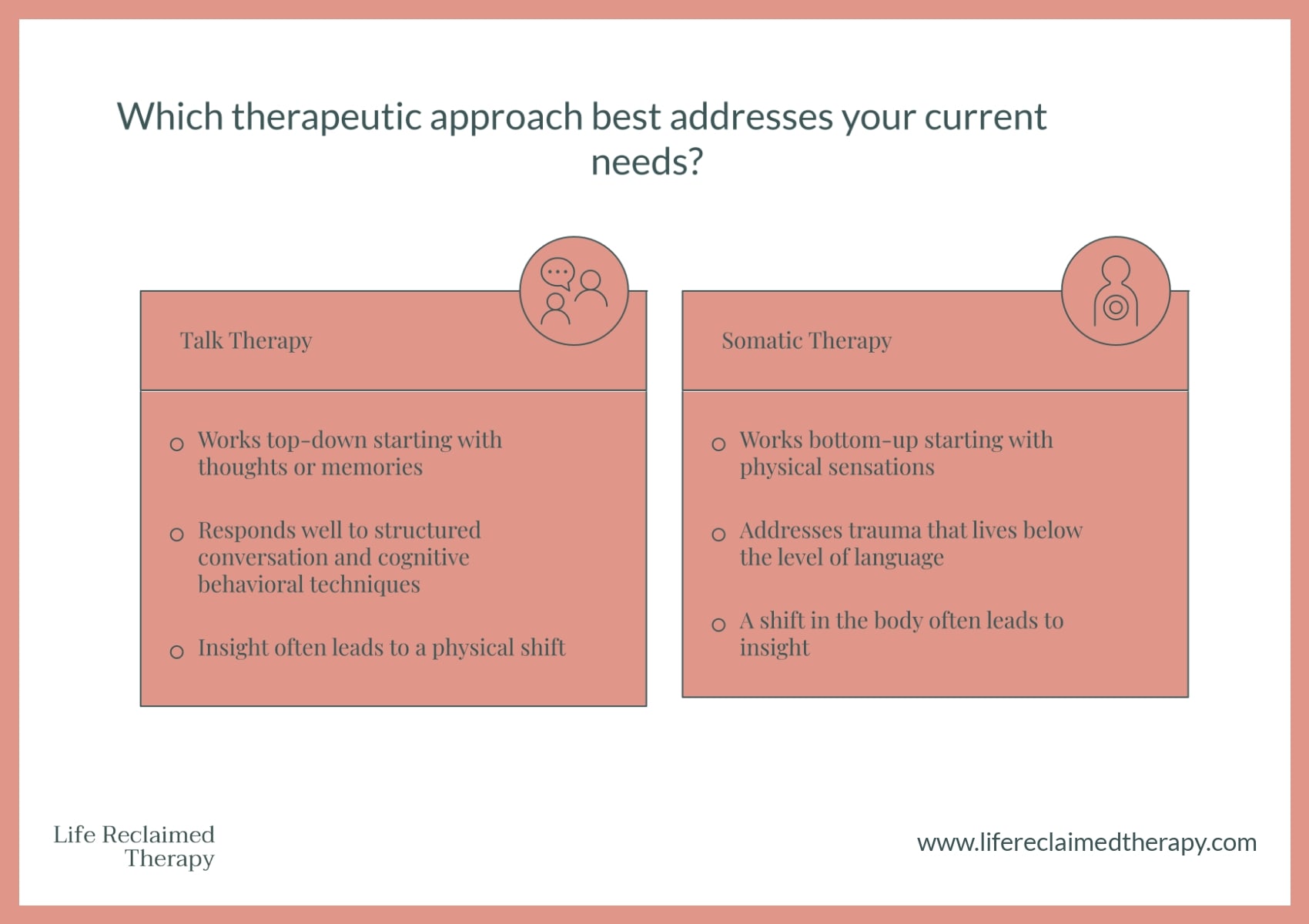
Here’s the simplest way I explain it to clients: traditional talk therapy tends to work top-down. You start with a thought or a memory, and you work toward feeling different. Somatic therapy works bottom-up. You start with a physical sensation, and you work toward understanding what it’s connected to.
Talk therapy: mind to body. Insight often leads to a physical shift.
Somatic therapy: body to mind. A shift in the body often leads to insight.
Neither direction is “more correct.” Some trauma responds beautifully to cognitive behavioral therapy and structured conversation. Some trauma, especially trauma that happened very young or very suddenly, lives below the level of language entirely and needs a body-based entry point.
If you’ve done solid talk therapy and still feel like something is unfinished, that’s usually a sign to add a somatic approach, not to start over.
Common Somatic Therapy Techniques (and What They Actually Feel Like)
A first somatic session can feel unfamiliar if you don’t know what to expect. Here’s a plain-language walkthrough of the somatic therapy techniques you’re most likely to encounter.
Somatic Therapy Examples: Techniques You Might Encounter in a Session
Body scanning. Your therapist gently guides your attention through different parts of your body, noticing tension, warmth, tightness, or numbness without judgment.
Grounding. Simple, sensory techniques (feeling your feet on the floor, noticing the texture of a chair) that bring you back into the present moment when a memory feels overwhelming.
Breathwork. Slow, intentional breathing that signals safety to your nervous system and helps regulate a racing heart rate or shallow breath.
Titration. A core Somatic Experiencing concept. Instead of diving into the most intense part of a memory, you approach it in small, manageable doses, so your nervous system never gets flooded.
Pendulation. Moving your attention back and forth between a place of discomfort and a place of ease in the body, which builds the nervous system’s capacity to handle distress without shutting down.
Resourcing. Identifying a memory, image, or physical sensation that reliably makes you feel calm or safe, so you have something to return to when things feel like too much.
None of these require you to relive your trauma in vivid detail. Good somatic work is paced, consensual, and always led by what your body can actually handle in the moment.
Can somatic therapy be done online?
Yes. Body awareness work translates surprisingly well to video sessions, since so much of it involves internal noticing rather than physical touch.
Types of Somatic Therapy: Which Modality Might Fit You?
There isn’t one single somatic approach. A few of the most established approaches include:
Somatic Experiencing (SE), developed by Peter Levine, focuses on helping the body complete the stress response that got interrupted during a traumatic event. It’s one of the more researched forms of somatic trauma therapy, with a growing base of clinical evidence.
Sensorimotor Psychotherapy blends body awareness with traditional talk therapy tools. It’s often a good fit for people who want a more structured, integrative approach rather than a purely body-focused one.
Hakomi leans into mindfulness, using gentle, present-moment noticing to surface unconscious beliefs and patterns held in the body.
Somatic elements also show up inside other trauma-focused modalities. EMDR, for example, works with the nervous system’s own reprocessing ability and pairs well with body awareness work. If you’re curious about how these fit together, I’ve written more about EMDR therapy and how it compares. Some people also find that IFS therapy, which works with different “parts” of yourself, pairs naturally with somatic awareness, since so much of parts work shows up physically too.
You don’t have to pick the “right” modality before you ever step into a room. A skilled somatic therapist will adapt to what your particular nervous system and history actually need.
Somatic Trauma Healing for Specific Types of Trauma
Trauma isn’t one-size-fits-all, and somatic trauma healing looks a little different depending on what you’ve lived through.
Complex PTSD and Childhood Trauma
When trauma happens repeatedly, especially in childhood, it tends to get woven into your baseline nervous system state rather than staying as one isolated memory. Somatic work here often focuses on slowly building a felt sense of safety in the body, sometimes for the first time.
Burnout and Identity-Based Trauma
Not all trauma comes from a single dramatic event. Years of overriding your own needs to meet impossible expectations, whether professional, familial, or cultural, can leave your nervous system chronically stressed, even without a textbook “traumatic incident.” If you’ve burned out chasing a version of success that wasn’t yours to begin with, somatic work can help you reconnect with what your body has been trying to tell you the whole time.
Relationship and Attachment Trauma
Betrayal, breakups, and unhealthy relationship patterns often leave a physical signature: a racing heart around conflict, a frozen stillness when someone raises their voice. My work with trauma therapy for women leans heavily on this because so much relational trauma is held in the body long before it makes it into words.
Racial and Sexual Trauma
These experiences carry particular weight, and they deserve a therapist who understands the specific dynamics involved, not a generic approach. Somatic therapy can offer a way to process what happened without forcing you to narrate every detail before you’re ready.
What to Expect in a Somatic Therapy Session
Your first somatic therapy session probably won’t look like what you imagine. There’s no lying on a table. No dramatic breakthrough on cue.
More likely, it starts with a conversation, the same as any therapy session. At some point, I might ask you to pause and notice what’s happening in your body as you talk. That’s it. That’s often the whole “unfamiliar” part people worry about.
From there, sessions tend to move at the pace your nervous system can tolerate. You are always in control. Nothing happens to you; things happen with you, at a speed you set. Over weeks and months, most people find that noticing sensation becomes more natural, almost like learning a new language for something your body already knew.
It’s completely normal for this to feel strange or even a little silly at first. That reaction is welcome here. Curiosity and skepticism are both fine places to start.
Is somatic therapy safe for everyone?
For most people, yes, when it’s paced appropriately by a trained therapist. If you have a complex trauma history, a therapist trained specifically in titration and pacing (rather than a general wellness practitioner) matters even more.
At-Home Somatic Exercises to Try Between Sessions
These are simple, supportive practices you can try on your own. They are not a replacement for working with a trained therapist, especially if you’re carrying complex trauma, but they can help you start building body awareness right now.
A Simple Grounding Body Scan
Sit or lie down somewhere quiet. Slowly bring your attention from your feet up to your head, pausing at each area for a few breaths. Just notice. You’re not trying to fix anything. You’re simply observing.
Breath-Based Regulation
Breathe in for a count of four, hold for four, and exhale slowly for a count of six. A longer exhale signals safety to your nervous system. Repeat for two or three minutes.
Gentle Shaking or Movement
Animals literally shake off stress after a threat passes; humans mostly override that instinct. Stand with your knees loose and gently shake out your hands, arms, and legs for thirty seconds. It can feel odd. It also genuinely helps discharge built-up tension.
Sensory Anchoring
Name five things you can see, four you can touch, three you can hear, two you can smell, and one you can taste. This pulls your nervous system out of a stress spiral and back into the present moment.
If any of these exercises bring up feelings or sensations that become overwhelming, stop and bring them to a session rather than pushing through alone.
How do I know if somatic therapy is right for me?
If you’ve done talk therapy and still feel stuck, if your body reacts more strongly than your mind expects, or if you’re simply curious about a different way in, it’s worth exploring. A free consultation is a low-pressure way to find out.
How Long Does Somatic Therapy Take? A Realistic Healing Timeline
I’d rather be honest with you than sell you a neat timeline that doesn’t hold up in real life.
Some people notice real shifts within eight to twelve sessions: less reactivity, better sleep, a steadier baseline. Deeper trauma resolution, especially for complex or childhood trauma, often takes longer, sometimes a year or more of consistent work.
Healing from trauma is rarely a straight line. You’ll likely have periods that feel like real progress followed by days when it seems as though you’ve slid backward. That’s not failure. That’s how nervous systems actually change.
What matters more than hitting a specific number of sessions is whether you’re noticing gradual shifts over time: a little more ease, a little less bracing, a little more trust in your own body.
Your Body Remembers. Let’s Help It Heal. Reach Out Today.
Trauma can be sneaky. It convinces you that if you just understood it well enough, you’d stop feeling it. But healing isn’t only an intellectual exercise. Sometimes it’s your body’s turn to finish what it started.
If any of this resonated with you, I’d love to talk. You can learn more about somatic therapy sessions at Life Reclaimed Therapy, or simply reach out and we’ll figure out together what your next step looks like. There’s no pressure here, only an open door whenever you’re ready to walk through it. Reach out!