


You’ve tried talking about it. Maybe you’ve journaled, set intentions, done the work. And yet there’s still this part of you that shuts down when you get close, or keeps saying you’re not enough, no matter how much evidence you pile up against it.
If that sounds familiar, you’re not broken. You might just have parts that haven’t had a chance to be heard yet.
IFS therapy, short for Internal Family Systems, is one of the most compassionate, non-judgmental therapy approaches I’ve come across. It’s the kind of work that makes people feel genuinely seen, sometimes for the first time. In this guide, I’ll walk you through what it actually is, how it works, and whether it might be the right fit for you.
Here’s what we’ll cover:
What Is IFS Therapy?
Internal family systems therapy (IFS) is a type of therapy that views the mind as made up of multiple distinct parts, each with its own feelings, beliefs, and protective role. Rather than treating difficult emotions as problems to eliminate, IFS asks: What is this part trying to protect?
Your mind isn’t one thing. It’s a whole inner world, full of different sub-personalities that developed at different points in your life, usually in response to pain, fear, or a need to survive.
IFS does not mean you have multiple personalities. In this model, “parts” are understood as normal aspects of the human mind, like the part of you that wants connection and the part of you that fears being hurt.
Let’s Find a Path Forward Together
If you’re tired of feeling overwhelmed, stuck in old patterns, or unsure what to do next, I’m here to help you reclaim emotional balance and clarity.
The “No Bad Parts” Principle
One of the things I find most powerful about this therapy approach is its foundational premise: there are no bad parts. None. Even the part of you that procrastinates, or drinks too much, or picks fights, or goes completely numb, that part has a reason. It learned to do what it does a long time ago, probably to keep you safe.
That’s a very different message than what most of us received growing up. And for a lot of my clients, it lands like a relief they didn’t know they were waiting for.
Curious whether IFS-informed therapy could help you?
I offer a free 20-minute consultation so we can figure out whether it feels like a good fit. Schedule your free consultation here.

Photo by Alex Green on Pexels
IFS Therapy Explained
IFS was developed by Richard Schwartz, a marriage and family therapist, beginning in the 1980s and becoming more widely known in the decades that followed. Dr. Schwartz noticed that his clients kept describing their inner experiences in terms of different voices or parts: “one part of me wants to do it, but another part is terrified.” He took that language seriously and built an entire model around it.
Schwartz was trained in family systems theory, the idea that you can’t understand one person without understanding the system around them. He brought that same thinking inward. Your internal system of parts works like a family: parts take on roles, protect each other, and sometimes fall into conflict.
That’s why it’s called Internal Family Systems. The “family” isn’t your parents or siblings. It’s the family living inside your own mind.
As a marriage and family therapist myself, that framing resonated with me immediately. The relational dynamics we see between people? They exist inside us, too.
What are the potential benefits and challenges of IFS therapy?
IFS therapy helps people release their burdens, reduce anxiety, heal trauma, and build self-compassion by understanding the parts driving their pain. The main challenge is that it requires patience. Real change takes time, and some protective parts resist the process before they trust it.
The IFS Therapy Model: Your Internal System of Parts
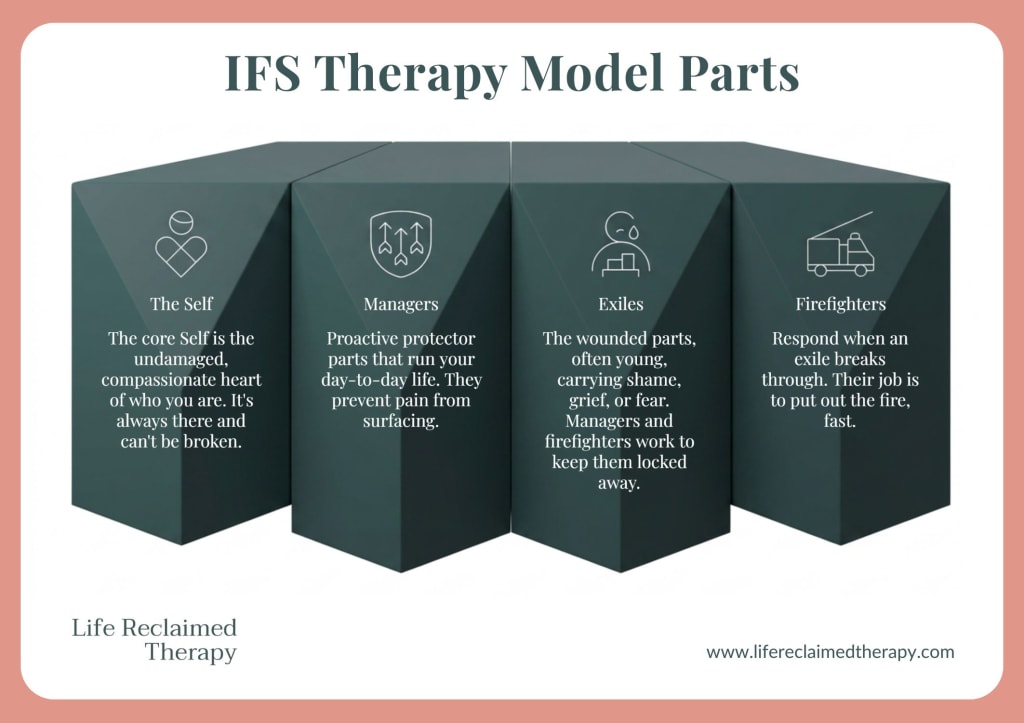
The IFS therapy model is built around three types of parts and one core Self. Once you understand these, the whole model clicks into place.
The Self: Your Source of Healing
At the center of IFS is the core Self, what Schwartz describes as the undamaged, compassionate, curious heart of who you are. The Self is always there, even when it’s hard to access. It doesn’t get traumatized. It can’t be broken. The goal of IFS-informed therapy is to help you lead your internal system from this place.
I describe Self energy to clients as that feeling of being calm, clear, and genuinely present. Not reactive, not overwhelmed. It’s the part of you that can sit with another part and say, I see you. Tell me what you need.
Managers, Exiles, and Firefighters
The three types of parts in the IFS model each play a distinct role in your internal system.
Managers are proactive protector parts that run your day-to-day life. They prevent pain from surfacing and often show up as perfectionism, people-pleasing, hypervigilance, or a relentless inner critic. They’re not bad. They’re exhausting, but they learned to keep you functional.
Exiles are the wounded parts, often young, carrying shame, grief, or fear from childhood trauma, abandonment, or rejection. Managers and firefighters work hard to keep exiles locked away because when they surface, the pain can feel unbearable.
Firefighters respond when an exile breaks through despite the managers’ efforts. Their job is to put out the fire, fast. They show up as impulsive or numbing behaviors: substance use, dissociation, rage, isolation. Again, not bad. Just desperate. They’re trying to stop a pain that feels too big to survive.
Understanding this framework genuinely changed how I see my clients’ struggles. When someone says, “I don’t know why I keep doing this,” IFS offers a real answer: a part of you learned that this was the fastest way to feel safe.
How IFS Parts Work in a Session
IFS parts work is what makes a session feel different from regular talk therapy. Rather than talking about your experience from a distance, you’re turning toward specific parts with curiosity and building a real relationship with them.
In practice, I might invite a client to notice a feeling that’s present, locate it in the body, and simply get curious: how old does this part feel? What is it worried about? How do you feel toward this part right now? If there’s judgment or shame, that’s usually another part. We work with that one first.
The deepest work in IFS is called unburdening. This is when a wounded exile finally gets to release the beliefs and emotions it took on during painful experiences. Burdens often sound like: I’m unlovable. I’m too much. It was my fault. When a burden is released, clients often describe a lightness they hadn’t expected.
That’s not me doing anything magical. That’s the kind of shift IFS can support: helping clients access more compassion, steadiness, and relief from beliefs they have carried for a long time.
Who should not do IFS therapy?
IFS may need to be adapted or used with extra caution for people experiencing active psychosis, severe dissociation, or current crisis symptoms. In these cases, it is especially important to work with a qualified mental health professional who can assess safety, stabilization, and whether IFS is the right approach.
What IFS Therapy Can Help With
IFS is a flexible psychotherapy model. Because it works with the underlying emotional structure rather than surface-level behaviors, it applies to a wide range of concerns.
Trauma and Emotional Pain
Healing trauma is one of IFS’s deepest strengths. A pilot effectiveness study found preliminary support for IFS as a promising approach to treating PTSD among adults with a history of childhood trauma. Unlike some trauma treatments that involve more direct exposure to traumatic memories, IFS often emphasizes building trust with protective parts first, so clients can approach painful material gradually and with support. For many people, that gentleness is exactly why it works.
Anxiety, Depression, and Internal Conflict
So much anxiety is actually internal conflict: one part pushing forward, another pulling back. IFS helps clients identify their parts so the conflict can finally be understood, not just managed. For depression, the IFS Institute notes that symptom reduction in depression is the most consistently supported outcome across multiple pilot studies.
Relationship Patterns and Self-Worth
The patterns that hurt us most in relationships, such as over-giving, avoiding conflict, or pushing people away, often come from protective parts. IFS-informed work helps clients understand why they keep showing up a certain way, and how to lead differently from Self. I see this constantly with my clients navigating life transitions, breakups, or new parenthood. The part that says “don’t need too much” often learned that message early. And it’s not the truth. It’s a burden an exile is still carrying.
Is IFS Therapy Evidence-Based?
IFS has a growing evidence base, though the research is still developing. Studies have explored IFS-informed interventions for concerns such as chronic pain, depression, trauma, and self-compassion.
A randomized controlled proof-of-concept study published in The Journal of Rheumatology found that an IFS-based intervention reduced pain and depressive symptoms in people with rheumatoid arthritis. A 2025 scoping review confirmed quantitative support for IFS across chronic pain, trauma, depression, and the development of self-compassion.
IFS is also a non-pathologizing model. It doesn’t label parts as dysfunctional or broken. That distinction matters more than it might sound, especially for clients who’ve spent years feeling like something is fundamentally wrong with them.
How does IFS therapy compare to other types of therapy?
CBT often focuses on identifying and changing thoughts, behaviors, and coping patterns. IFS focuses more on building relationships with inner parts and understanding the protective roles they play. Both can be helpful, and the best fit depends on the person, their goals, and the therapist’s training.
Is IFS Right for You?
IFS tends to be a strong fit if any of these resonate:
You feel like part of you knows better, but another part keeps doing the old thing anyway
You’ve done therapy before and understood your patterns intellectually, but couldn’t actually change them
You carry a lot of self-criticism or shame, and you’re exhausted by it
You have a trauma history and want to work with it at your own pace, without feeling pushed
You’re ready to go deeper than symptom management and understand why you are the way you are
IFS-informed therapy is also very accessible via online therapy, something I’ve seen work beautifully with clients across California. The internal work doesn’t require you to be in the same room. If you’re also navigating anxiety, trauma, or a major life transition, IFS fits naturally into all of that work.
What If the Part You’ve Been Fighting Is Trying to Help?
I became an IFS-informed therapist because I’ve seen what happens when people stop fighting their parts and start listening to them. The shift is real. It’s not about becoming someone different. It’s about finally coming home to who you already are.
The parts you’ve been fighting hardest? They’re usually the ones that need the most compassion. That’s the heart of IFS, and it’s the heart of the work I do in Calabasas and online across California. If any of what you read today felt like something you’ve been waiting to hear, let’s talk.
The first step is a free 15-minute consultation. You tell me a little about what’s going on, I’ll ask a few questions, and we’ll figure out together whether we’re a good fit. Reach out here to get started.