


You know that feeling when part of you wants to burn it all down and start over, and another part is white-knuckling the wheel, trying to keep everything from falling apart? That’s not you being dramatic. That’s your internal family system doing exactly what it was built to do.
The IFS therapy parts model has grown fast, and for good reason. IFS has emerging empirical support, including randomized controlled trials, and was previously listed in SAMHSA’s now-archived National Registry of Evidence-based Programs and Practices (NREPP). A 2013 randomized trial in The Journal of Rheumatology reported clinical benefits for people with rheumatoid arthritis; by that time, more than 2,200 therapists worldwide had already trained in the model.
I’ve watched that same framework help women in my Calabasas practice finally understand why they feel like three different people before 9 a.m.
Here’s what we’ll get into:
If any of this sounds familiar, keep reading. And if you’d rather just talk it through, I’m happy to set up a free 15-minute consultation whenever you’re ready.
What Is the IFS Parts Model, Really?
The IFS parts model, short for the Internal Family Systems model, is a psychotherapy rooted in systems theory, developed by Richard Schwartz, a family therapist who noticed his clients kept describing their inner world in family-like terms.
It asks you to picture your mind as a family made up of various parts, sometimes called subpersonalities. Each one carries its own role, feelings, and history, almost like family dynamics playing out inside your head.
Each part formed for a reason, usually to help you survive something, and each one is still trying to help, even when it’s causing you trouble now. Recognizing that your parts are trying to help, even the ones that seem destructive, can be one of the most relieving aspects of IFS.
At the center of it all is what IFS calls Self-energy. Think of Self as the calm, curious, compassionate leader of your internal family. The Self doesn’t need to fix or silence any part. It just needs enough room to lead.
The Role of the Self in IFS: Your Inner Compass
In the IFS model, the Self isn’t another part. It’s who you are underneath all of them, your core Self, and it’s always intact, even when it feels buried. One of the founding principles of IFS is Self-leadership: the idea that this core Self, not any single part, is meant to run the show. The IFS Institute describes this through what’s often called the 8 Cs: calm, curiosity, clarity, compassion, confidence, courage, creativity, and connectedness.
You don’t have to build the Self or earn it. It’s already there, underneath your inner parts, part of the same inner system that includes your Managers, Firefighters, and Exiles. The work is mostly about helping your Managers and Firefighters step back enough to let Self lead, much like a good parent stepping in when the kids are overwhelmed, not to punish them but simply to help.
This is the heart of parts work: helping your parts trust that Self can actually handle things, so they don’t have to work so hard. IFS teaches that all parts of Self have a positive intention, even when their behavior feels harmful.
Are IFS and parts therapy the same?
Yes, “parts therapy” is often just a casual way of referring to IFS. Internal Family Systems is the formal name for the specific model behind that phrase.
Meet Your IFS Protectors: Managers and Firefighters
In IFS, protector parts do exactly what the name says. They protect you, usually from pain that got tucked away a long time ago. There are two types of protectors, and they show up very differently. Here are a few IFS parts examples you might already recognize in yourself.
IFS Managers: The Ones Running the Show
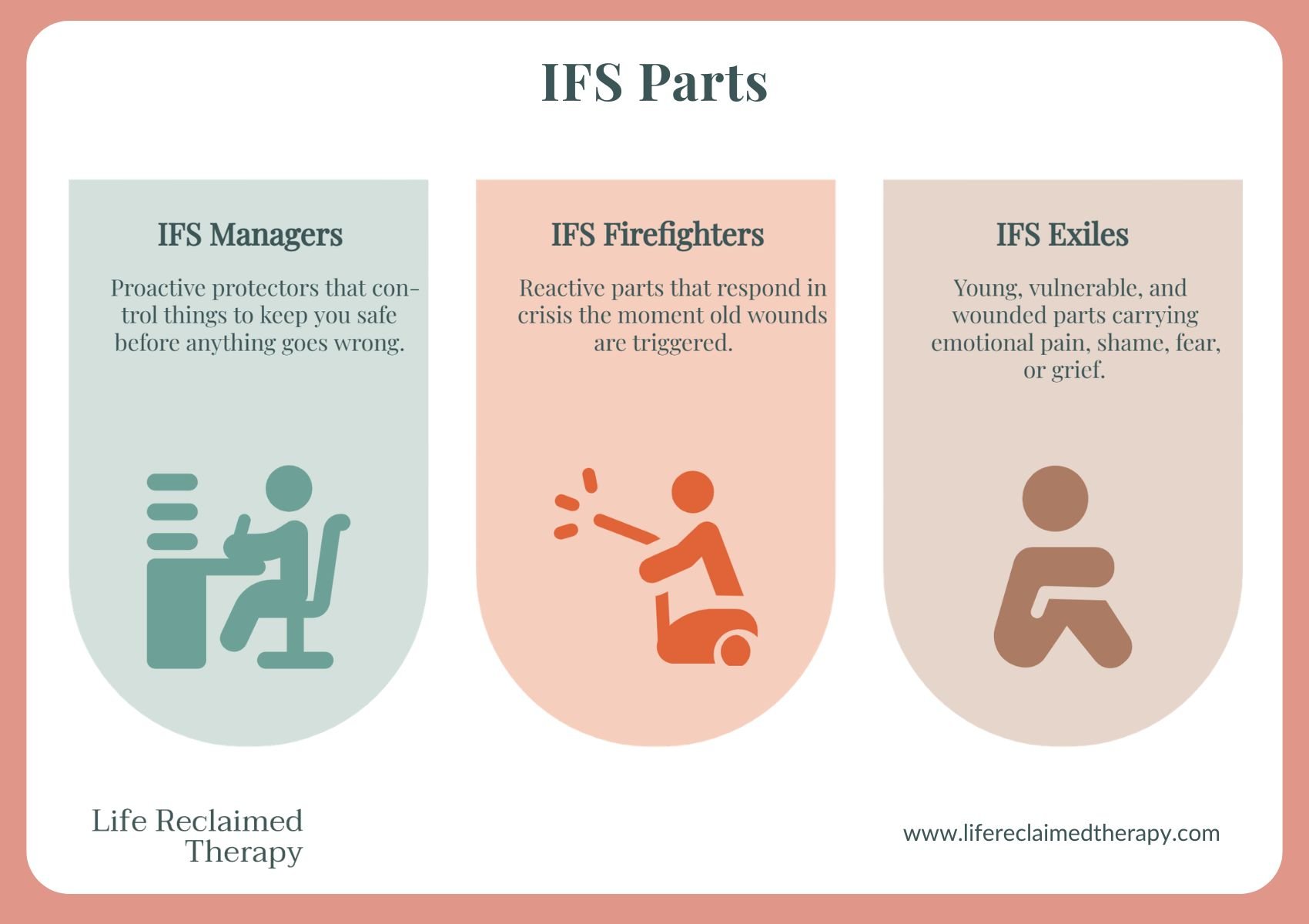
IFS Managers are protective parts: the planners, the perfectionists, and the inner critics. As proactive protectors, Managers try to keep you safe by controlling things before anything can go wrong.
I hear this constantly in my work. One part won’t let the to-do list rest until every box is checked. Another rehearses a difficult conversation fifteen times before it happens, just in case. Maybe it’s the part that rewrites the same email four times before hitting “send” or says yes in a meeting when every other part of you is screaming no. Those aren’t flaws. They’re protector parts working overtime, often for a woman who’s been rewarded her whole life for holding it all together.
This pattern shows up a lot in high-achieving women specifically. A pilot study on IFS and depression in college women found real, measurable relief once participants started working with these exact protector parts instead of white-knuckling through them.
When a Manager gets loud enough, it can look a lot like anxiety, even though what’s actually happening is a part trying to keep you one step ahead of getting hurt again.
IFS Firefighters: The Ones Who Show Up in Crisis
IFS Firefighters are reactive parts that respond the moment old wounds are triggered. Firefighter parts show up after a Manager loses control and an Exile’s pain breaks through. Their job isn’t pretty, but it’s protective.
This might be the part that scrolls for three hours instead of sleeping. The part that reaches for a second glass of wine after a hard day. The part that shuts down mid-conversation with no warning. These internal parts aren’t bad. They’re doing crisis management the only way they learned how.
What are the 3 types of IFS parts?
The three types are Managers and Firefighters, which are both protector parts, and Exiles, which carry old pain. Managers act ahead of time to prevent hurt, Firefighters react once pain breaks through, and Exiles hold the feelings underneath both.
IFS Exiles: The Parts Carrying the Old Pain
Exiles are the parts of us that stayed young, the young parts, vulnerable parts, and wounded parts of the Self. Each Exile holds emotional pain, shame, fear, or grief that felt too overwhelming at the time, so Managers and Firefighters learned to keep these parts locked away.
Maybe it’s the part of you that still feels like you failed when your marriage ended. Or the part that began to feel invisible the moment you became someone’s mom instead of simply yourself. Or the part that still feels like the kid who was never quite enough, no matter how much you accomplished. Those Exile parts didn’t disappear. They’ve just been managed, quietly, for years, which is exactly why your Managers and Firefighters work so hard.
Healing from trauma, in IFS terms, usually means helping an Exile unburden the pain it’s been carrying instead of holding that burden alone. A lot of the deeper healing in IFS therapy for trauma happens here, once your protectors trust Self enough to let an Exile finally be witnessed instead of shut down.
Wondering if this pace would feel right for you?
If any of this is landing a little too close to home, that’s usually a good sign, not a bad one. I offer IFS-informed therapy in Calabasas and online across California, and I’d be glad to talk it through with you.
What Happens When Your Parts Are in Conflict?
Parts don’t always agree, and internal conflicts like this are often where people get stuck. Say one part of you desperately wants to quit a job that’s burning you out, while another part is terrified of disappointing your family or losing your sense of identity. Neither part is wrong. They’re just pulling in different directions, both trying to protect you in their own way.
IFS doesn’t ask you to pick a side or silence either part. Instead, it helps the two negotiate, almost like a family meeting, so the part that wants to quit can slow down, and the part that’s scared can feel heard instead of overridden. That’s usually when a thoughtful decision, rather than a reactive one, becomes possible.
Blending vs. Unblending: When a Part Takes Over
When a part takes over completely, IFS calls that blending. It sounds like “I am anxious” or “I am such a mess.” When you can notice a part without becoming it, that’s unblending, and it sounds more like “A part of me feels anxious right now.”
Using parts language like this, even just in your own head, is one of the first shifts clients notice, and it’s often the difference between a part running the show and Self being back in the driver’s seat.
Common Myths About IFS Parts
The biggest misconception I run into is that having parts means having multiple personalities. It doesn’t, and the difference matters, especially since every part in IFS is a normal, expected piece of being human. Meeting your parts with self-compassion and greater kindness, rather than frustration, is one of the biggest shifts I see in clients.
Myth: The IFS parts model is the same as DID. Dissociative identity disorder affects roughly 2% of the general population and involves real gaps in memory between identity states. Having parts is universal and doesn’t work that way.
Myth: Some parts need to be eliminated. IFS holds that there are no bad parts, only parts stuck in exhausting jobs they took on to protect us within this internal system.
Myth: You need major trauma to benefit from parts work. Everyday stress, people-pleasing, and burnout respond to it too. You don’t need a dramatic backstory to start.
Is having different parts a sign of a mental illness?
No. Everyone has multiple parts, and that alone doesn’t mean you have dissociative identity disorder or any other condition. IFS parts are a normal way the mind organizes itself, not a diagnosis.
What IFS Parts Work Actually Feels Like
This is where parts work actually happens, not just in theory. Unlike some forms of traditional talk therapy, which may focus primarily on discussing a problem, an IFS session may feel less clinical than it sounds. I’ll usually ask you to notice where you feel a part in your body, then get curious about it instead of pushing it away. In IFS parts therapy, the goal isn’t to eliminate any part; it’s to help every part feel less alone.
Most clients are surprised by how much of the work happens in quiet moments during therapy sessions. They may notice tightness in their chest, name it, and ask what it is trying to protect them from rather than jumping straight into fixing it.
Can You Do IFS Parts Work on Your Own?
You can absolutely start mapping your parts on your own. Journaling and simple body-noticing are two of the easiest techniques to help you get to know your parts. Pausing to ask, “Which part of me is driving right now?” is one of the simplest tools you can use, since naming a part can often reduce its intensity.
But burnout makes this harder. Women report burnout at notably higher rates than men, according to recent workplace data, and an exhausted protector is a hard one to reason with solo. That’s usually when working with an IFS-informed therapist matters most, especially when the work involves an Exile whose deeper pain may require more support than journaling alone can offer.
What does it mean to unblend from a part?
Unblending means creating enough distance from a part to notice it with curiosity instead of becoming it completely. Instead of “I am furious,” it feels more like “a part of me is furious,” which gives your Self room to lead again.
Ready to Get to Know Your Parts? Here’s How I Can Help
Getting curious about your own parts, especially the ones you’ve spent years trying to outrun, takes real courage. That’s exactly the kind of work I love doing.
As an IFS-informed therapist, I bring that lens into every session, and I’ll pair it with whatever actually helps you, whether that’s EMDR therapy, CBT, or somatic approaches. You don’t have to figure out which approach is right before we start. That’s what I’m here for.
I offer in-person internal family systems therapy in Calabasas and online therapy throughout California. If any of this resonated, even a little, I’d love to hear from you. Reach out to schedule a free 15-minute consultation, and we’ll figure out together what your parts have been trying to tell you.