


Starting EMDR therapy can bring up a mix of curiosity, hope, and a little apprehension. That makes sense.
Whether you’re healing from a traumatic event, navigating a divorce, adjusting to motherhood, or trying to reconnect with yourself after a big change, EMDR can help your brain and body process what’s been stuck so you can move forward with more clarity and confidence.
EMDR is actually a very structured, collaborative process. Nothing happens without preparation, and we move at a pace that feels steady and manageable for you.
Understanding the EMDR phases often eases some of that initial nervousness. In this guide, we’ll walk through:
If you’re wondering whether EMDR could support your next chapter, this is a gentle place to start.
Let’s Find a Path Forward Together
If you’re tired of feeling overwhelmed, stuck in old patterns, or unsure what to do next, I’m here to help you reclaim emotional balance and clarity.
Healing at Your Pace: Inside the 8 Phases of EMDR Therapy
EMDR, short for eye movement desensitization and reprocessing, is a structured, research-supported approach that helps the brain reprocess distressing experiences so they feel less overwhelming in the present.
Developed by psychologist Francine Shapiro, EMDR is widely used to support healing after a traumatic event or periods of high stress. Studies have shown EMDR can significantly reduce trauma symptoms, with organizations like the American Psychological Association recognizing it as an effective treatment for trauma-related distress.
The eight phases of EMDR therapy provide a clear, supportive roadmap. We begin with phase 1, where we create a thoughtful treatment plan. From there, each phase of EMDR therapy unfolds at your pace. Not every session involves intense desensitization or processing.
The steps of EMDR therapy are collaborative and designed to help your nervous system integrate past experiences gently.
What are the 8 stages of EMDR?
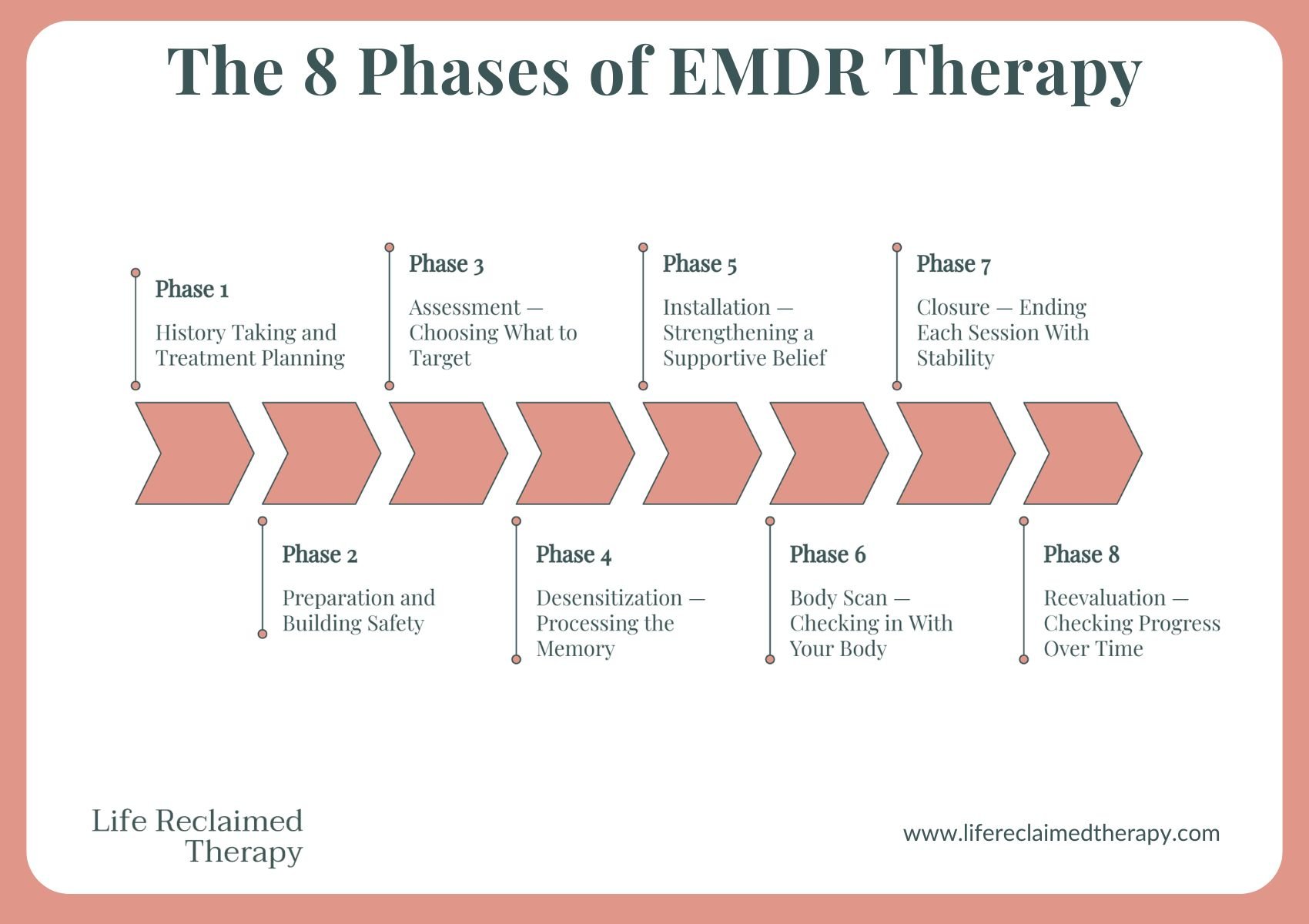
The 8 phases of EMDR therapy are: history taking, preparation, assessment, desensitization, installation, body scan, closure, and reevaluation.
Phase 1: History Taking and Treatment Planning
Before we do any processing, we spend time understanding what you’ve been carrying and what you want to feel different.
This phase is conversational and collaborative. We’re connecting dots, not rushing into anything.
In this phase, we:
- Talk through your history and what’s bringing you to therapy
- Identify patterns from past experiences that still feel charged
- Notice current stressors, transitions, and emotional triggers
- Begin shaping a personalized treatment plan
- Discuss what the later phases will look like, so nothing feels surprising
- Set a pace that respects your nervous system and your life outside therapy
We also begin identifying patterns like negative beliefs (“I’m not enough”), emotional triggers, and body sensations. Together, we create a thoughtful treatment plan and talk through what the later phases will look like, so nothing feels unexpected. Phase 1 helps you feel informed, supported, and grounded before moving forward.
Phase 2: Preparation and Building Safety
Before we process difficult memories, we focus on helping you feel safe and resourced. In this EMDR phase, we practice skills that support your nervous system and help you stay present.
For example, we might:
- Create a calming mental “safe place” you can return to during sessions
- Practice grounding skills for moments when emotions spike
- Learn how to notice body tension and gently release it
- Try light bilateral stimulation so it feels familiar and comfortable
- Identify supportive beliefs like “I can handle this” or “I’m safe now.”
This phase is about building trust and making sure you feel ready. You won’t be pushed into anything before your system has the tools it needs. When that foundation is in place, we move forward together at a pace that feels steady and supportive.
How long does each phase of EMDR last?
Each phase of EMDR therapy varies. The first phase and preparation phase may take several sessions, while the later stages can move faster.
Phase 3: Assessment — Choosing What to Target
In this phase of EMDR therapy, we identify a target memory, related negative experience, emotions, and the cognition or belief connected to it.
In Phase 3, we:
- Clarify the memory or situation we’ll work on
- Notice traumatic memories, triggers, and body reactions
- Identify a desired positive belief or positive cognition
- Rate distress using subjective units of disturbance
“Subjective Units of Disturbance,” often shortened to SUDs, is just a way for you to tell me how upsetting something feels right now on a scale from 0 to 10.
- 0 = no distress at all
- 10 = the most intense distress you can imagine
There’s no right or wrong number. It’s not a test. It’s just a quick check-in so we can track how your nervous system is responding.
Many people notice the number gradually drops as the brain begins to reprocess the memory. What once felt like an 8 might shift to a 3, then eventually a 0 or 1.

Phase 4: Desensitization — Processing the Memory
This is the phase many people feel most curious about, but it’s not about dramatically reliving anything. Instead, we return to the memory we chose together and allow your brain to process it in small, supported steps using bilateral stimulation such as eye movements or tapping.
You stay present. You stay in control. We move at a pace that feels manageable.
In Phase 4, we:
- Focus on the chosen memory while staying grounded in the present
- Notice thoughts, emotions, and body sensations as they arise
- Use bilateral stimulation to support processing
- Pause often to check in and regulate if needed
- Allow the brain to reduce the emotional charge of the memory naturally
Over time, many clients notice the memory feels less intense and less intrusive. The goal isn’t to erase the memory. It’s to help it feel less overwhelming.
Phase 5: Installation — Strengthening a Supportive Belief
Once the distress connected to the memory begins to ease, we shift toward reinforcing a belief that feels more aligned with who you are now. This might be something like, “I’m safe,” “I’m allowed to move forward,” or “I’m stronger than I thought.”
We don’t force positivity. We help your system feel the truth of a more supportive belief.
In Phase 5, we:
- Identify a positive belief you want to hold about yourself
- Notice how true that belief feels in your body
- Use bilateral stimulation to strengthen that belief
- Allow confidence and clarity to build naturally
- Support integration of the new perspective
This EMDR phase often feels encouraging and grounding. Many women start to feel a shift in how they see themselves and their past.
Phase 6: Body Scan — Checking in With Your Body
Even when a memory feels less charged emotionally, the body can sometimes carry lingering tension. This phase gives us space to notice any remaining physical discomfort or stress connected to the memory.
In Phase 6, we:
- Gently scan the body for any tension or discomfort
- Notice subtle sensations like tightness or heaviness
- Process anything that still feels activated
- Support the body in releasing leftover stress
- Help the nervous system settle fully
This step helps the healing feel more complete. We want both your thoughts and your body to feel calmer.
What is EMDR used for?
EMDR is an effective treatment for trauma and other mental health conditions like anxiety, grief, and stress from life transitions.
Phase 7: Closure — Ending Each Session With Stability
No matter how far we get in processing, we always make sure you leave feeling grounded and steady. This phase is about helping your nervous system settle before you return to your day.
In Phase 7, we:
- Use grounding or calming techniques
- Help your body return to a regulated state
- Review what came up during the session
- Offer tools to support you between sessions
- Make sure you feel stable before leaving
You won’t be sent back into your day feeling overwhelmed. This phase ensures you leave feeling supported and centered.
Phase 8: Reevaluation — Checking Progress Over Time
At the start of future sessions, we check back in on the memory we worked on and how you’ve been feeling since the last session. This helps us see what has changed and what still needs support.
In Phase 8, we:
- Revisit the memory and notice how it feels now
- Check whether distress has decreased
- See if the positive belief still feels true
- Identify anything new that surfaced
- Decide together what to focus on next
This phase reminds us that healing happens over time. Many clients notice that situations that once felt overwhelming now feel more manageable, and they begin to feel more like themselves again.
Who is EMDR not good for?
EMDR may not be the best fit if someone is in acute crisis or lacks stability and support. A trained EMDR therapist will assess readiness during phases 1 and 2 and can recommend other approaches first.
If EMDR Therapy Is on Your Mind, Here’s How We Begin
If you’re thinking about EMDR, we want you to know the space we create together is warm, collaborative, and paced with care. We work primarily with millennial women who are carrying the impact of trauma and navigating big life transitions like divorce, career changes, or becoming a parent.
Our work is steady and thoughtful. We talk, we build skills, and we move through the EMDR process in a way that respects your nervous system and your life outside therapy.
If you’d like to learn more about how we offer EMDR, get in touch. You’re welcome to reach out whenever it feels right.