


When you care deeply, it’s easy to give and give until there’s nothing left for yourself. If you’ve ever felt like you’re constantly meeting your partner’s emotional needs while neglecting your own, you might be caught in a codependent relationship. And you’re far from alone; codependent tendencies often start as kindness, loyalty, or a desire to help. Over time, though, that caring tendency can blur into codependent behavior, where love becomes overgiving and self-worth depends on someone else’s happiness.
In this article, we’ll explore:
Ready to start finding your way back to a healthy relationship? Let’s talk about how to care for others without abandoning yourself.
What Is a Codependent Relationship?
A codependent relationship is a relationship dynamic where one person feels overly responsible for their partner’s emotions, needs, or choices. Instead of sharing mutual support, one person becomes the caregiver, constantly trying to fix, please, or manage the other. Over time, that caring turns into imbalance, and you might start to lose your sense of self in the process.
In healthy love, both people can have space for their own needs and wants. But in codependent relationships, it often feels like your entire world revolves around your partner’s needs. You might find yourself saying yes when you mean no, or avoiding conflict because you fear it could lead to rejection or disconnection.
Are codependent relationships fixable?
Yes, they are. Once both partners recognize the signs of codependent behavior, healing can begin. With therapy, couples can shift from unhealthy behavior patterns to healthier, more balanced ways of connecting.
Common Codependency Signs and Symptoms You Might Recognize
- Feeling responsible for your partner’s happiness or choices.
- Difficulty setting boundaries or expressing what you truly need.
- A deep fear of rejection or abandonment.
- Constantly sacrificing your own needs to keep the peace.
- Feeling anxious or guilty when you take time for yourself.
- Repeating dysfunctional patterns of behavior, especially choosing partners who need rescuing.
Let’s Find a Path Forward Together
If you’re tired of feeling overwhelmed, stuck in old patterns, or unsure what to do next, I’m here to help you reclaim emotional balance and clarity.
If this feels familiar, you’re not broken; you’re just operating from learned survival strategies that once kept you safe. Healing is possible. With awareness, therapy, and gentle boundary work, you can break the cycle of codependency, rebuild a strong sense of self, and create an interdependent relationship, one where love feels balanced, not burdensome.
You deserve to be in a healthier relationship, one where care flows both ways.
What Causes Codependency?
Codependency is often a learned survival strategy, something that develops long before you enter a romantic relationship. Many codependent people grew up in homes where love, safety, or attention depended on keeping others happy. Over time, this becomes a habit: anticipating partner’s needs and wants, avoiding conflict, and losing touch with your own.
Family Dynamics and Early Roles
If your primary caregiver struggled with substance abuse, unpredictable moods, or emotional neglect, you may have stepped into the role of the helper or peacemaker. Research shows that people raised in dysfunctional family systems often grow up believing they must earn love through caretaking. These early experiences can create deep-seated beliefs like “My needs don’t matter” or “If I fix everything, I’ll be safe.”
Attachment Style and Emotional Safety
Your attachment style, the blueprint for how you connect with others, can also play a role. People with anxious attachment often fear rejection and overextend themselves to maintain closeness, while those with avoidant attachment may over-focus on independence, making emotional connections feel unsafe. A 2022 study found that early attachment disruptions strongly predict codependency issues and difficulty setting boundaries in adulthood.
If you struggle with codependency, pause and gently ask yourself: “What did I learn about love, care, and conflict growing up?” Awareness is the first step toward healing from codependency and beginning to build a healthier relationship, one where you feel seen, safe, and free to be yourself.
How to end a codependent relationship?
If you’re in a relationship that feels one-sided or draining, start by focusing on your own wants and needs. Ending codependency doesn’t always mean breaking up; it can mean redefining your role in the relationship and learning new boundaries with the help of a therapist.
How Do I Know If I’m Codependent?
Maybe you’ve noticed that your happiness rises and falls with how your partner is feeling, or that you’re constantly checking in to make sure everyone around you is okay while quietly ignoring your own needs. These moments can be confusing, especially when your care comes from a good place. But when caring starts to mean losing yourself in the process, it may be time to pause and look closer.
Here are a few gentle questions to reflect on:
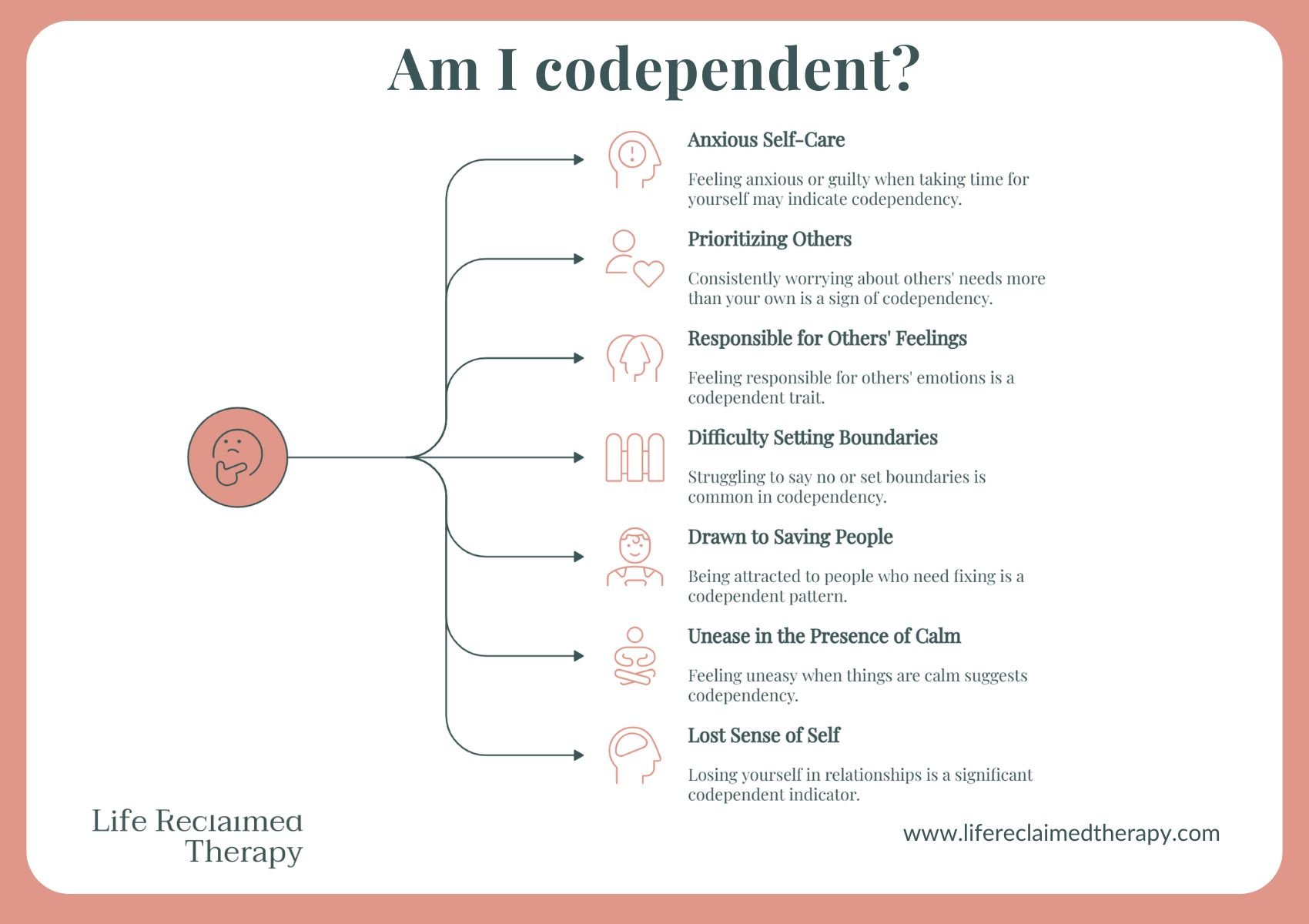
- Do you feel anxious or guilty when you take time for yourself?
- Do you often worry about your partner’s needs and wants more than your own?
- Do you feel responsible for how your friend or partner feels?
- Is it hard for you to set boundaries or say no?
- Do you find yourself drawn to people who need “saving” or fixing?
- Do you feel uneasy when things are calm, as if something must be wrong?
- Have you ever lost your sense of self in a romantic relationship?
If several of these feel familiar, it doesn’t mean something is wrong with you; it means you’ve developed patterns that once helped you feel safe or connected. Codependent people often learn early on that love is something you earn by being needed or keeping the peace.
Recognizing these signs of codependency is the first step toward change. With support, self-awareness, and practice, it’s absolutely possible to build a healthier relationship. Therapy can help you untangle these patterns and start healing from codependency in a way that feels gentle, grounded, and true to who you are.
How to Stop Being Codependent
If you’ve realized you’re caught in codependent ways, that’s already a powerful first step. Awareness opens the door to healing. You don’t have to overhaul your entire relationship with someone overnight; real change happens slowly, with gentleness and practice.
Recovering from codependency requires both self-awareness and the courage to try new emotional habits, especially around communication and boundaries. Here’s where to start:
1. Notice Your Patterns
Start by recognizing the signs of when you slip into fixing, rescuing, or taking responsibility for your partner’s needs. Do you feel anxious when you’re not helping? Guilty for saying no? These are clues that you’re stepping into old roles that no longer serve you.
2. Practice Setting Boundaries
Setting boundaries can feel uncomfortable at first, especially if you grew up in a home where limits were ignored. But healthy limits protect you and make space for a connection built on respect. Start small:
- Say no without overexplaining.
- Ask for time to think before agreeing to something.
- Notice how you feel when you honor your own needs.
Boundaries aren’t walls; they’re bridges to more honest, balanced communication.
3. Rebuild Your Sense of Self
In a dysfunctional relationship, it’s easy to lose your sense of identity. Try reconnecting with what makes you feel grounded and alive: creative hobbies, friendships, or solo time. Building a strong sense of self helps you show up in love as a whole person, not just a caretaker.
4. Seek Professional Help
Therapy can help you address codependency at its root. Cognitive Behavioral Therapy (CBT) is especially effective for challenging self-blame and reframing the belief that your worth depends on someone else’s happiness. A mental health professional can guide you through healing patterns and building emotional resilience.
EMDR Therapy (Eye Movement Desensitization and Reprocessing) can also address the root of codependent tendencies, helping you process the early experiences that shaped your beliefs about love and care. It’s a powerful tool for transforming negative self-statements like “I’m a burden,” “My feelings don’t matter,” or “I’m unlovable” into more balanced, compassionate truths: “I’m lovable,” “My feelings are valid,” and “I’m worthy of love.”
Healing doesn’t mean you’ll never fall back into old habits; it means you’ll catch yourself sooner, respond differently, and recover faster. With compassion and steady effort, you can overcome codependency and learn how to love in a way that’s free, balanced, and real.
Common Examples of Codependent Relationships
Codependent relationships can take many forms; they’re not always dramatic or obvious. Sometimes they look like love, dedication, or deep care on the surface, but underneath, one person’s identity and well-being begin to revolve around the other’s. What they all share is an imbalance: one person over-functions while the other under-functions, and both feel stuck.
Here are a few common examples of codependent relationships you might recognize:
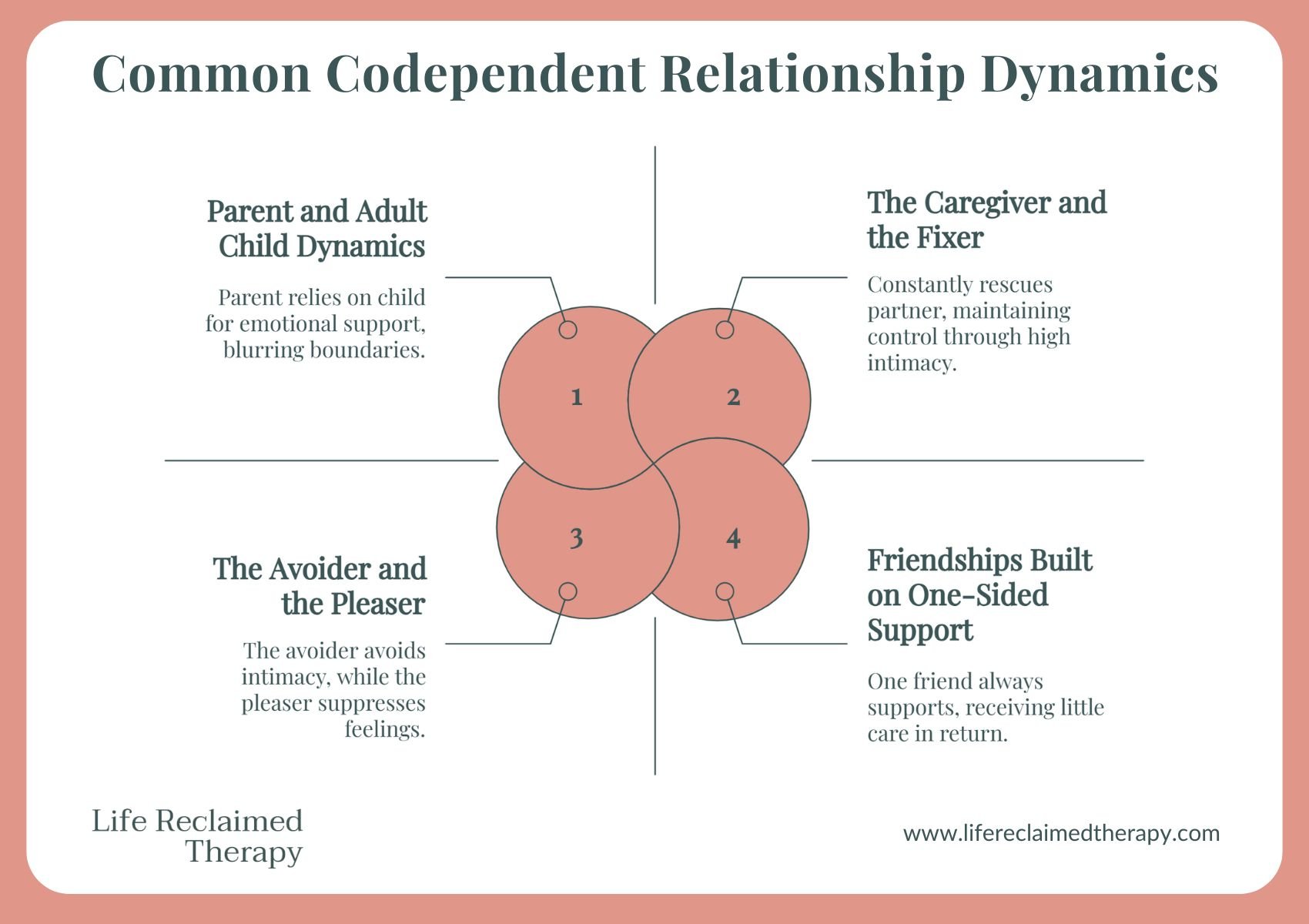
The Caregiver and the Fixer
One person constantly rescues or “fixes” their romantic partner, taking on their problems, emotions, or even their responsibilities. The relationship feels stable only when the fixer is in control.
The Avoider and the Pleaser
One person avoids emotional intimacy, while the other works overtime to keep the connection alive, avoiding conflict, suppressing their feelings, and putting their partner’s needs first.
Parent and Adult Child Dynamics
A parent relies on their grown child for emotional support, while the child feels guilty about setting limits or saying no. This can blur boundaries and delay independence.
Friendships Built on One-Sided Support
A friendship where one person is always the listener, problem-solver, or emotional anchor, but rarely receives the same care in return.
In all of these situations, the person in the relationship may begin to lose their sense of self, confusing love with responsibility or self-sacrifice. Over time, this creates exhaustion, resentment, or even anxiety and depression.
Recognizing these patterns isn’t about blame; it’s about clarity. The goal isn’t to walk away from connection, but to build a healthier relationship where both people can stand on their own and still choose to stand together. With self-awareness and support, you can begin to break the cycle of codependency and relate in a way that feels freer, more balanced, and more true to you.
Can You Fix a Codependent Marriage or Relationship?
A codependent marriage can heal, but it takes honesty, willingness, and a shared commitment to doing things differently. These relationships don’t need to end for change to happen; they need to evolve.
In many codependent relationships, one partner gives too much while the other gives too little. Over time, that imbalance can lead to resentment, emotional distance, or burnout. But once both people start recognizing these patterns, it becomes possible to create a more balanced, interdependent relationship, one where each partner feels responsible for their own emotions and still connected in a loving, supportive way.
Healing often begins when:
- Both partners agree to stop the “rescuer” and “avoider” dynamic.
- The person in the relationship who tends to over-function practices setting boundaries and naming their own needs.
- The partner who tends to withdraw learns to take more responsibility for their actions and emotional impact.
- Both begin to communicate openly and honestly, even when it feels uncomfortable.
Working with a therapist, either individually or through marriage and family therapy, can make a huge difference. Therapy focused on boundary-setting and emotional regulation can significantly improve relationship satisfaction and reduce dependency patterns.
It’s important to remember: healing isn’t about blame. It’s about learning new ways to connect with yourself and your partner. When you start prioritizing emotional honesty, shared responsibility, and self-respect, your relationship can shift from codependent to connected.
So yes, you can fix a codependent relationship. But the real goal isn’t just saving the relationship; it’s helping both people grow into healthier, more authentic versions of themselves together.
What is the root cause of codependency?
Codependency often stems from early low self-esteem, inconsistent caregiving, or abusive behavior. These experiences teach people to meet others’ needs before their own. Therapy helps you unlearn these behavior patterns.
Reconnect With Yourself and Build Healthier Relationships
If you’ve been feeling stuck in old relationship patterns – overgiving, people-pleasing, or losing yourself in love – therapy can help you find your way back to balance. In individual relationship counseling, we’ll look at the deeper roots of those patterns and gently begin to rewrite them.
I tailor our work to your needs, drawing from a range of evidence-based approaches, including Cognitive Behavioral Therapy (CBT), EMDR Therapy (Eye Movement Desensitization and Reprocessing), and mindfulness-based practices, such as somatic therapy. Together, we’ll explore where your patterns began, how they’ve shaped your relationships, and what healing might look like now.
You don’t need to have everything figured out to start. You just need a space that feels safe enough to be honest, curious, and real. Start therapy today and take the first step toward a calmer, more connected you.