


Divorce is one of the only losses we experience where the person we’re grieving is still walking around, maybe even texting us about pickup times for the kids. That makes the grief real, even when the world around you keeps expecting you to just move on.
Research backs up what you’re feeling in your body right now. The CDC’s National Center for Health Statistics tracks a divorce rate of roughly 2.4 per 1,000 people in the U.S. each year, and most researchers estimate that somewhere between 39% and 45% of first marriages will eventually end in divorce. That’s millions of people every single year walking through the exact stages of grief in divorce that you’re walking through right now. You are not alone in this, even when it feels like you are.
In this guide, I’ll walk you through:
What Are the Stages of Grief in Divorce?
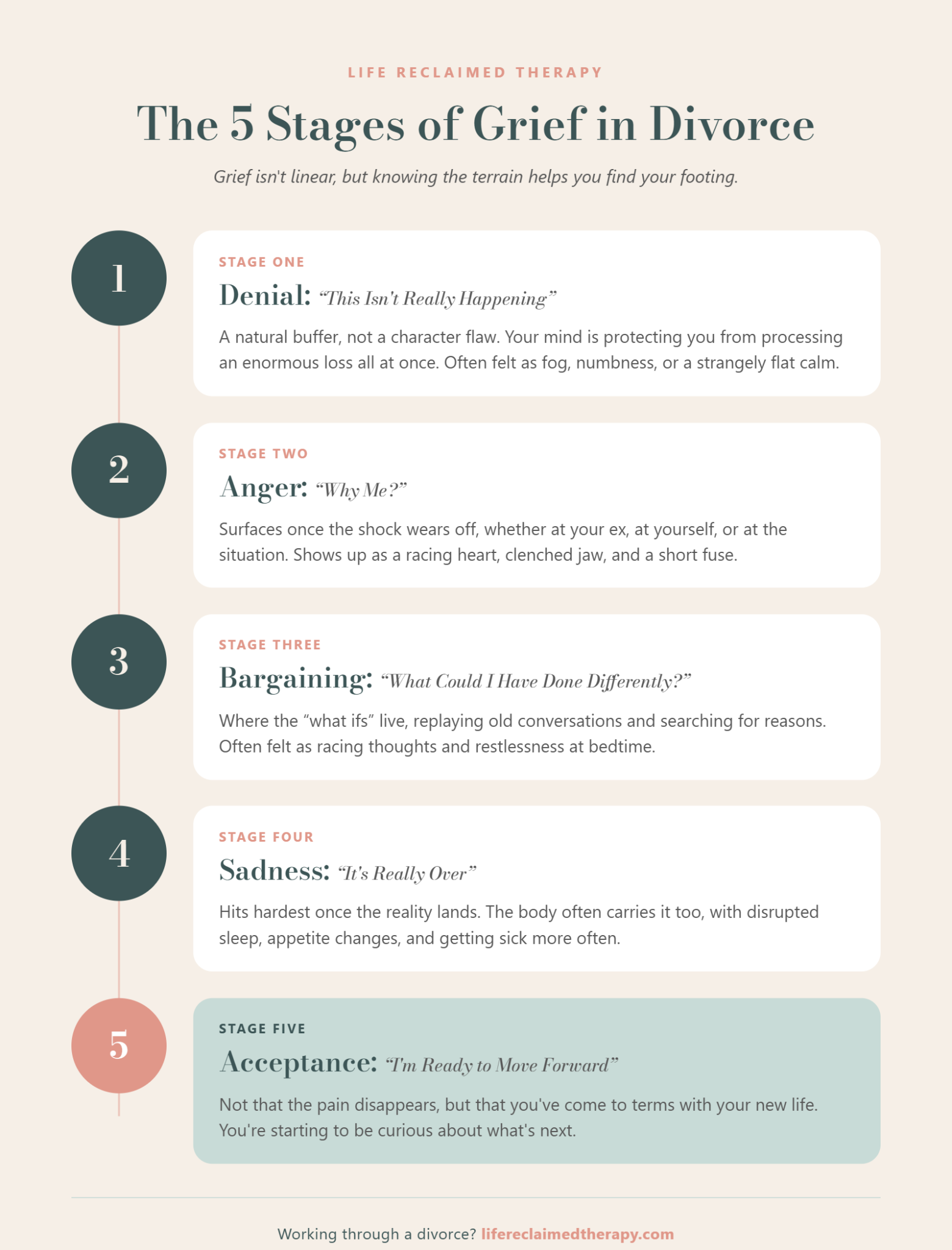
The stages of grief in divorce are denial, anger, bargaining, sadness (often called depression), and acceptance. This framework comes from psychiatrist Elisabeth Kübler-Ross, who first described it in her 1969 book On Death and Dying. She originally developed it to describe how people process the news of their own terminal illness, not divorce specifically, but the emotional pattern maps closely onto the grieving process that happens when a marriage ends. It’s normal to experience these stages out of order, skip one entirely, or land back in a stage you thought you’d already worked through.
Let’s Find a Path Forward Together
If you’re tired of feeling overwhelmed, stuck in old patterns, or unsure what to do next, I’m here to help you reclaim emotional balance and clarity.
Is It Normal to Grieve During a Divorce?
Yes, it’s completely normal, even if you initiated the divorce, even if it was amicable, and even if everyone around you keeps saying “it’s for the best.” Divorce is a major life change that touches every area of your life: your home, your finances, your friendships, your identity, and your sense of what your future looks like. You’re not just losing a person. You’re losing the shared plans, the in-laws, the Sunday routines, and the version of yourself that existed inside that marriage.
Because your former partner is still alive, this kind of grief often goes unacknowledged by the people around you. Psychologists call this “ambiguous loss,” a term coined by researcher Pauline Boss to describe grief with no clear resolution or closure. You may have heard the phrase “social death” used to describe this. It’s not literal, obviously, but it captures something real: divorce ends a social role and identity even though there’s no physical death and no funeral to mark it. That absence of ritual is part of why the grieving process can feel so confusing and so lonely.
If you’re navigating a high-conflict split on top of all this, our guide on divorcing a narcissist covers some of the added emotional weight that comes with that specific situation.
What are the 5 stages of grief in divorce?
The five stages are denial, anger, bargaining, sadness (depression), and acceptance. They come from Elisabeth Kübler-Ross’s original grief model, adapted here to the specific experience of divorce.
How Long Do the Stages of Grief in Divorce Last?
There’s no fixed timeline for grief in divorce, but most people move through the most intense phase over six months to two years, with lingering waves for longer than that. Grief specialists generally describe three loose phases: an acute phase in the first one to six months where emotions are rawest, an adjustment phase from six months to two years where things start to stabilize, and an integration phase from two to five years where the divorce becomes part of your story rather than the center of it.
What Affects Your Grief Timeline?
A few things tend to speed up or slow down your process:
How the marriage ended. A sudden, blindsided ending often takes longer to process than a slow, mutual drift apart.
Whether you initiated the divorce. More on this below, but initiators and the partners left behind tend to move through grief on different schedules.
Whether kids are involved. Co-parenting keeps you in regular contact with your former partner, which can stretch out certain stages.
The length and intensity of the marriage. Longer marriages, or ones with high conflict, tend to come with more layers to grieve.
Whether you have support. People with a strong support network tend to move through the grieving process more steadily than people who isolate.
None of this is a race. Healing isn’t linear, and it’s normal to feel like you’ve “arrived” at acceptance only to find yourself back in sadness a few weeks later.
Not sure what to do with yourself right now?
The 30-Day No Contact Healing Plan gives you a gentle, day-by-day guide for exactly this season.
Stage 1: Denial – “This Isn’t Really Happening”
Denial is usually the first stage in the stages of grief in divorce, and it shows up as a kind of emotional buffer. Your mind isn’t trying to deceive you. It’s trying to protect you from processing an enormous loss all at once. Denial is a natural defense mechanism, not a character flaw.
In this early stage of the divorce process, you might notice yourself:
Throwing yourself into distractions, like work, renovation projects, or your kids’ schedules, to avoid sitting with what’s happening
Holding on to a false sense of hope that reconciliation is still possible
Suppressing your emotions rather than letting them surface, which usually just delays things
What Does Denial Feel Like in Your Body?
Denial often shows up physically before it shows up emotionally. Clients describe feeling foggy, disconnected from their own body, or strangely calm in a way that doesn’t match the situation. Some people describe it as feeling numb, like they’re watching their own life from a few feet outside it. Trouble concentrating and a flat, dreamlike quality to daily life are both common.
How Can You Move Through Denial?
Let yourself name what’s happening out loud, even just to yourself or a journal
Avoid making big decisions during this phase if you can help it. Your future self will thank you for waiting until your thinking is less foggy
Consider working with a divorce therapist who can gently help you build tolerance for the reality of the loss, at your own pace
Denial isn’t about weakness. It’s a natural part of the grieving process, and moving beyond it is the first real step toward lasting healing.
Stage 2: Anger – “Why Me?”
Anger tends to surface once the initial shock wears off and the reality of the divorce process starts to sink in. This stage of divorce grief can feel intense, sometimes surprisingly so, especially if you don’t think of yourself as an angry person.
Anger during this phase can point in a few directions:
At your former partner, for the choices they made or the ways they hurt you
At yourself, in the form of guilt and self-blame over what you could have done differently
At the situation itself, or even at cultural expectations around marriage and failure
What Does Anger Feel Like in Your Body?
Anger tends to run hot: a racing heart, clenched jaw, tight shoulders, trouble sleeping, and a short fuse with people who have nothing to do with your divorce. Some people also notice digestive issues or headaches during this phase. Chronically elevated stress hormones can also weaken your immune system over time, which is part of why many people report getting sick more often during a divorce.
How Can You Cope with Anger in a Healthy Way?
Journal it out. Writing down the unfiltered version of your anger is a safe way to release it without saying something to your ex or your kids that you’ll regret
Move your body. Exercise is one of the most effective tools for metabolizing stress hormones and anger
Talk it through. Sessions with a mental health professional give you a space to be fully honest without managing anyone else’s feelings
Anger is not something to be ashamed of. It’s part of the natural process of grief, and expressing it safely is part of how you move through it rather than getting stuck in it.
Can you skip stages of grief in a divorce?
Yes, it’s common to skip a stage entirely, revisit one you thought you’d finished, or experience them in a completely different order. There’s no required sequence.
Stage 3: Bargaining – “What Could I Have Done Differently?”
Bargaining is where the “what ifs” and “if onlys” tend to live. You might replay conversations, wonder if a different approach could have saved the marriage, or catch yourself fantasizing about reconciliation even if you know, logically, that it’s not the right path.
During this stage, it’s common to:
Question past choices and wonder if things could have gone differently
Long for reconnection, even briefly, even if the relationship wasn’t healthy
Search for reasons, trying to make sense of something that may never fully make sense
What Does Bargaining Feel Like in Your Body?
Bargaining often shows up as restlessness: racing thoughts at bedtime, difficulty sitting still, or a low hum of anxiety that makes it hard to focus on anything else. Some people describe a tight chest or a stomach that won’t settle, especially right after checking their ex’s social media or replaying an old text thread.
How Do You Move Past Bargaining?
This phase is temporary, even when it doesn’t feel that way. It’s essential to acknowledge these thoughts without dwelling on regret. Try grounding yourself with a simple question: Is this thought helping me understand my past, or is it keeping me stuck in a false sense of control over something I can’t change? A licensed therapist can help you separate the two and refocus on goals that actually move you forward.
Stage 4: Sadness – “It’s Really Over”
Sadness, sometimes called the depression stage, often hits hardest once the reality fully lands: the marriage is over, and life has changed in ways you can’t undo. This deep sadness can feel like a heavy weight that follows you through your day.
Common experiences during this stage include:
Loneliness, especially in the absence of daily intimacy and companionship
A persistent ache that touches everything from your emotional state to your physical health
Regret and loss, often triggered by small reminders of your former partner or your shared life
What Are the Physical Symptoms of Grief During Divorce?
This stage tends to hit the body the hardest. Divorce activates a prolonged stress response, and Oklahoma State University Extension notes that when that stress goes untreated, it can affect your immune system, digestion, sleep, and emotional regulation. Recent research cited by OSU Extension found that divorced individuals experience depression at rates two to nine times higher than the general population. Physical symptoms to watch for during this stage include:
Trouble falling or staying asleep, or sleeping far more than usual
Loss of appetite, or the opposite: stress eating and weight changes
Fatigue that doesn’t improve with rest
Getting sick more often (colds, flu, or generally feeling run-down)
Headaches, muscle tension, or an upset stomach
These symptoms are your body’s way of carrying stress that it hasn’t had a chance to process yet. They’re common, but they’re also worth mentioning to your doctor if they’re severe or lasting more than a few weeks.
How Do You Cope with the Depression Stage?
Keep a basic routine, even a small one. Regular meals and a consistent sleep schedule give your nervous system something steady to hold onto
Let yourself feel the sadness without judgment. Suppressing it tends to make it last longer, not shorter
Reach out, even when you don’t feel like it. Isolation tends to make this stage feel bigger and lonelier than it needs to
If sadness feels unrelenting or you’re having thoughts of not wanting to be here, please reach out to a mental health professional right away
This grief stage is often the hardest to navigate, but allowing yourself to feel it, without judgment, is essential for real healing.
Stage 5: Acceptance – “I’m Ready to Move Forward”
Acceptance is the final stage in the stages of grief in divorce, but it’s also the most misunderstood. Acceptance doesn’t mean you’re suddenly fine with everything that happened, and it doesn’t mean the pain of divorce disappears overnight.
What Does Acceptance Actually Mean?
Acceptance means you’ve come to terms with the reality of your new life, not that you’ve forgotten or excused what happened. In this stage, people often start to:
Feel a renewed sense of purpose and direction
Notice glimpses of hope about what’s next
Recognize their own resilience, sometimes for the first time in a long time
How Do You Know You’ve Reached Acceptance?
You’ll likely still have hard days. That doesn’t mean you’ve gone backward. Acceptance tends to show up as an underlying sense that even with the pain, you still have a future, and you’re starting to be curious about what it looks like. Many people find themselves ready to reconnect with old friends, explore new relationships, or simply enjoy a quiet Tuesday without the weight of grief sitting on their chest the whole time.
Is it normal to still love your ex during the grieving process?
Yes. Loving someone and knowing the relationship needs to end aren’t contradictions. Lingering love, especially during bargaining and sadness, is a normal part of grieving a long relationship.
Do the Stages of Grief Happen in Order?
Not usually, and that’s completely normal. Even Kübler-Ross herself later said the five stages weren’t meant to be a rigid checklist. You might feel acceptance on a Monday and land right back in anger by Thursday. You might skip bargaining altogether or spend far more time in sadness than anger. None of that means you’re doing grief wrong. It means you’re a person moving through a major life change in the way that fits your particular story.
Instead of asking “Am I in the right stage?” it can help to ask, “What do I need right now?” That question tends to be more useful than trying to force your grief into a straight line.
Does Grief Look Different When You Have Kids vs. When You’re Child-Free?
Yes, and understanding the difference can help you be more patient with yourself. If you’re co-parenting, your former partner doesn’t disappear from your life. You’re negotiating schedules, attending school events together, and having ongoing conversations, all of which can slow down certain stages, especially bargaining and acceptance, simply because you don’t get the clean break that allows some people to fully close that chapter.
If you’re child-free, the practical break tends to be cleaner, but that comes with its own challenge: fewer built-in reasons to maintain a routine, and sometimes a sharper sense of isolation since there’s no shared custody calendar structuring your week.
A few things that help either way:
With kids: try to keep co-parenting conversations businesslike and boundaried, saving the emotional processing for your support system or a therapist, not your ex
Child-free: build intentional structure into your week (regular plans with friends, a new class or hobby) since you won’t have co-parenting logistics doing that for you by default
If You Initiated the Divorce, Do You Still Grieve?
Yes, and this often surprises people. There’s a common assumption that if you’re the one who left, you must feel relief and nothing else. In reality, research published in the Proceedings of the National Academy of Sciences found that while people who initiate a separation tend to see their well-being improve afterward, the process still involves real grief, guilt, and loss along the way, even when leaving was the right choice.
If you initiated the divorce, you might notice:
Guilt and self-blame, even when you know the relationship wasn’t working
Grief for the version of the future you once imagined with your former partner
Pressure to “have it together” since you made the choice, plus isolation if friends or family are unsure how to support you
Relief that sits right alongside sadness, sometimes in the very same hour
None of these feelings cancel each other out. You’re allowed to feel both relief and grief. You’re allowed to know it was the right decision and still mourn what you’re losing.
What Role Does a Support Network Play in Healing?
A bigger role than most people expect. Research on stress and recovery consistently shows that people with strong social connections cope better with major life stressors than people who go through it alone. Your support network doesn’t need to be huge. It can be one or two people who show up consistently: a friend who checks in, a sibling who lets you vent without trying to fix it, a support group of people who actually understand what you’re going through.
Ways to build or lean on your support network right now:
Say yes to low-pressure social invitations, even when you don’t feel like it
Consider a divorce support group, in person or online, where you don’t have to explain the backstory every time
Let people help in small, practical ways (a meal, a ride, watching the kids for an hour)
Reciprocate when you can. Support networks tend to hold up better when they go both directions
If your existing circle feels thin right now, divorce counseling can give you a steady, consistent point of support while you rebuild the rest of your network.
Does co-parenting make divorce grief harder?
It can extend certain stages, since regular contact with your former partner doesn’t allow for a full break. Clear boundaries around co-parenting communication can help you protect your healing process while still working together for your kids.
Which Stage of Grief Are You In? A Quick Self-Check
If you’re not sure where you land, this can help you get a general sense of it. Grief doesn’t fit into a tidy checklist, but most people recognize themselves in one or two of these right away.
You feel foggy, distracted, or like this can’t really be happening. → Denial
You feel irritable, on edge, or find yourself replaying arguments in your head. → Anger
You catch yourself thinking “what if” or wondering if reconciliation is still possible. → Bargaining
You feel a heavy, persistent sadness, low energy, or changes in sleep and appetite. → Sadness
You still have hard days, but you’re starting to feel curious about your future again. → Acceptance
Wherever you land today, it’s not permanent. You might check this list again next month and see something completely different, and that’s exactly how grief is supposed to work.
Is the 5-Stage Model the Only Way to Understand Grief?
No, and it can genuinely help to know that. The Kübler-Ross model is the most widely known framework, but it’s not the only one, and it wasn’t originally designed for divorce grief specifically.
Psychologist J. William Worden proposed an alternative: four tasks of mourning rather than five passive stages. Worden’s model focuses on active tasks like accepting the reality of the loss, processing the pain, adjusting to a new environment without your former partner, and finding a way to move forward while still honoring what the relationship meant.
If the five-stage model doesn’t quite match your experience, Worden’s task-based approach might feel like a better fit. There’s no single “correct” framework. What matters is finding language that helps you make sense of what you’re going through.
When Should You Reach Out to a Mental Health Professional?
Grief is a normal part of the divorce process, but there are moments when extra support makes a real difference. Consider reaching out to a mental health professional if:
Sadness feels unrelenting, or you feel stuck in one stage for months without any shift
You’re relying on alcohol, food, or other substances to manage difficult emotions
Making decisions, even small ones, feels overwhelming
You’re isolating yourself completely from friends and family
You’re having thoughts of not wanting to be here
None of these means something is wrong with you. They mean you’re carrying more than anyone should carry alone, and therapy can help you put some of that weight down.
Healing Through the Stages of Grief in Divorce with Life Reclaimed Therapy
I won’t pretend this is easy. Divorce touches every area of your life, and the stages of grief that come with it don’t move on anyone else’s timeline but your own. What I can tell you, both as a therapist and as someone with lived experience of heartbreak, is that you’re not meant to do this without support.
In my practice, I work with clients through every stage: denial, anger, bargaining, sadness, and acceptance, using patience, evidence-based tools like EMDR and CBT, and zero judgment for however messy your process looks.
If trauma from the relationship itself is part of what you’re carrying, EMDR therapy can be especially helpful for processing it. And if part of what you’re grieving is your own sense of identity outside the marriage, individual relationship counseling can help you rebuild that from the ground up.
Divorce is a major life transition, and like any life transition, it asks a lot of you before it gives anything back. But it does give something back. Most of my clients come out the other side of this process stronger and wiser, with a clearer sense of who they are than they had before. You will too